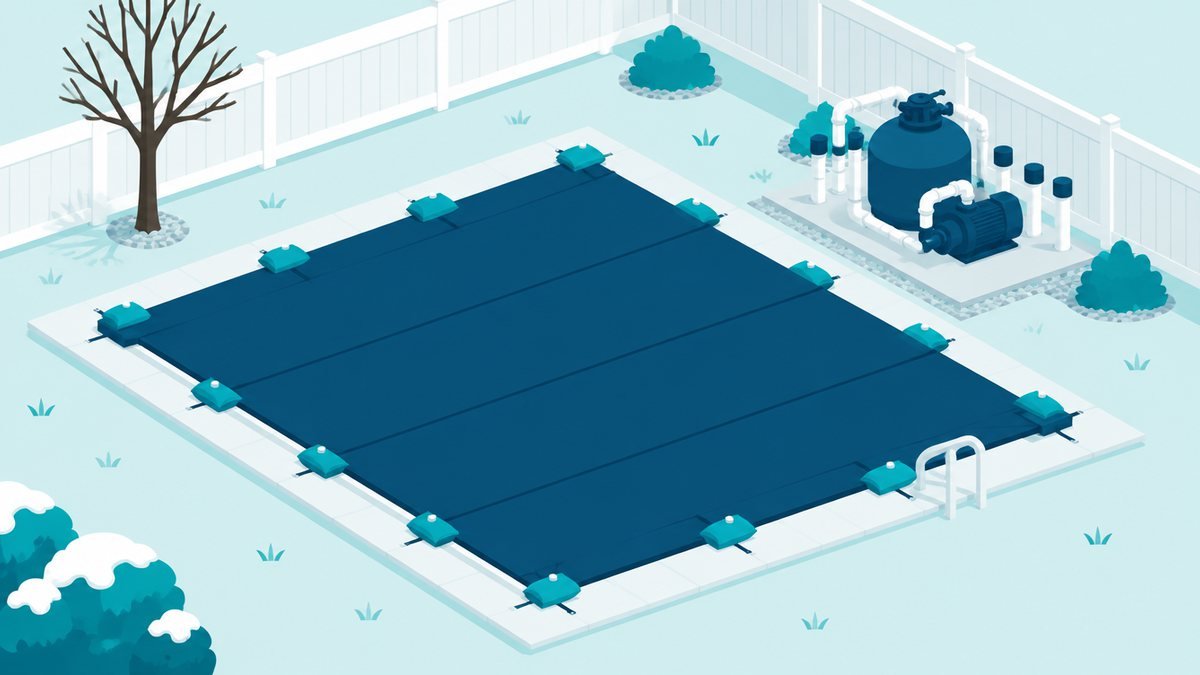
How to close a pool for winter comes down to this: clean and balance the water, add winterizing chemicals, lower the water level as your manuals direct, drain and plug the equipment and lines so no water can freeze inside them, and fit a secure cover. Done in that order, it protects your pump, filter, heater and pipes from freeze damage and leaves you a much easier pool to open in spring. Climate, pool type and equipment change the details, so follow the owner’s manual for each piece of gear.
What you need before you close the pool
Gather everything first, so the job doesn’t stall halfway with water still in the lines.
- A good water test kit. The CDC recommends a DPD-type kit for accurate chlorine and pH readings.
- Winterizing chemicals sold for your type of pool, and a shock product, used exactly as the labels direct.
- A skimmer plug or winter plug set, and the drain plugs for your equipment.
- A wet/dry shop vacuum or air blower, if you plan to blow out the lines yourself.
- A cover that fits, with water bags or an air pillow as the cover instructions require.
- Your owner’s manuals for the pump, filter, heater and any salt cell or chlorinator.
How to close a pool for winter, step by step
1. Clean the pool
Skim leaves, brush the walls and floor and vacuum, then empty the skimmer and pump baskets. Debris left in the pool feeds algae under the cover, and that is the usual cause of a green pool in spring.
2. Balance the water
Test and adjust before you add anything else. The CDC recommends keeping pH between 7.0 and 7.8. For total alkalinity, Taylor Technologies lists 80 to 120 ppm as ideal. Our guide to how to raise pH in pool water explains the adjustment, and you should always retest after the water has circulated.
3. Shock the water and add winterizing chemicals
Pentair advises shocking the water before you add winterization chemicals. Use each product exactly as its label says, add them one at a time, never mix products and never pour one chemical into another.
4. Lower the water level
Pentair notes that reducing the water level helps with freeze protection and lowers the chance of an overflow. How far to lower it depends on your cover and skimmer design, so check your cover and equipment instructions. Don’t drain an inground pool completely unless a professional tells you to.
5. Clean and winterize the filter
Backwash a sand filter first. Pentair’s Triton manual then says to shut the pump off, open the manual air bleeder and, with a multiport valve, set the valve to WINTERIZE and leave it there until the system restarts after freezing weather. See our pool sand filter guide for how these valves work.
6. Drain the equipment and remove the plugs
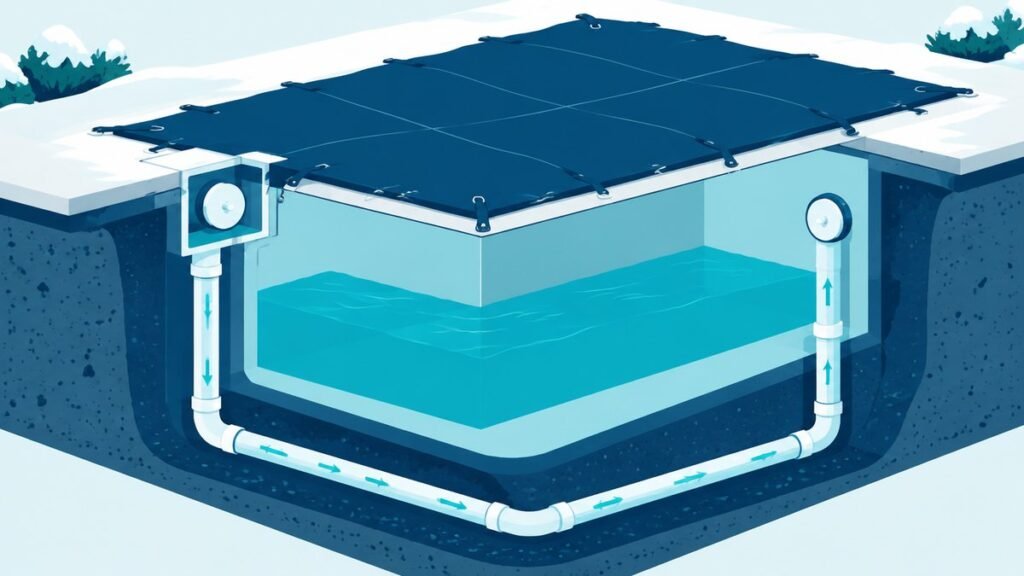
Turn off power to the pump, heater and any salt system at the breaker. Then drain the pump, filter, heater and chlorinator, and remove their drain plugs. Pentair’s reminder is simple: don’t forget to remove the plugs, and store them somewhere you will find them in spring.
7. Blow out the lines and plug the openings
Water trapped in a pipe is what splits it when it freezes. Pentair says a pool professional will blow out the equipment lines so no water is left, and will usually fit a plug in the skimmer. If you do it yourself, clear each line completely and plug the skimmer and return fittings as the plug set instructs.
8. Fit and secure the cover
Check the cover for holes or abrasions first. Secure an inground cover with water bags as its instructions require. On an above-ground pool, Pentair suggests an air pillow to relieve the weight of rain, snow and ice. A cover that sags or has gaps is a hazard, so inspect it after storms. Our guide to the pool cover pump covers removing water from the top of a cover.
Inground and above-ground pools: what changes
The steps are the same, but the details differ. Inground pools rely on plugs in the skimmer and returns and on blown-out underground lines, and they stay full to a lowered level. Above-ground pools often have simple hoses and a small filter and pump that can be drained and brought indoors. The manufacturer’s winterizing instructions for your model always win over general advice.
Common mistakes to avoid
- Closing a dirty pool and hoping the chemicals will cope.
- Skipping the test and adding chemicals in the wrong order.
- Leaving water in the pump, filter or heater.
- Forgetting to remove drain plugs, or losing them.
- Using household or automotive antifreeze. Don’t add antifreeze unless a manual for your equipment names the exact product.
- Leaving a cover loose, torn or collecting water.
When to open it again
In spring, remove the cover, clean it before storing it, put the plugs back and restart the equipment carefully. Our guide on how to open a pool walks through it.
Equipment notes: heater, salt system and accessories
Each piece of equipment has its own winter needs, so read its manual. A gas heater or heat pump holds water in its heat exchanger, so follow its manual for cutting the power, disconnecting the inlet and outlet unions if it says to, and letting the unit drain fully. A salt chlorinator cell should be removed or protected as its maker says. Automation panels and timers need power switched off and moisture kept out. Ladders, rails and diving boards come out and are stored dry, and skimmer baskets and returns get cleaned and left ready for spring.
A simple closing checklist
| Area | What to do | Basis |
|---|---|---|
| Water | Test and balance (pH 7.0 to 7.8, alkalinity 80 to 120 ppm), shock, then add winterizing chemicals as labeled | CDC, Taylor, Pentair |
| Water level | Lower it as your cover and manuals direct, and don’t drain an inground pool completely | Pentair |
| Filter | Backwash, shut the pump off, open the air bleeder and set a multiport valve to WINTERIZE | Pentair Triton manual |
| Equipment | Switch off power, drain the pump, filter, heater and chlorinator, and remove the plugs | Pentair |
| Lines and skimmer | Blow out the lines and plug the skimmer and return fittings | Pentair |
| Cover | Check for holes, then secure it with water bags (inground) or an air pillow (above ground) | Pentair |
What to check during winter
A closed pool still needs an occasional look. Clear snow and leaves from the cover when it is safe to do so, make sure it is still tight and has no tears, and keep water from pooling on top of it. If the water level rises or drops a lot, find out why before spring.
Frequently asked questions
When should I close my pool for winter?
Close it once the weather has turned reliably cold and before the first hard freeze. Cold water slows algae, which makes a good cleaning and chemical balance last longer.
Do I need to blow out the pool lines?
In places that freeze, yes. Water left in pipes can freeze and split them, so lines are blown clear and plugged. Many owners hire a pool professional for this step.
Can I use antifreeze in my pool plumbing?
Don’t, unless a manual for your equipment names a specific pool-safe product. Automotive antifreeze is toxic and can damage equipment.
Should I drain the pool for winter?
No. Lower the water level as your cover and equipment instructions direct, but don’t drain an inground pool completely unless a professional advises it.
Sources
Always check the manual for your exact model. These manufacturers and public agencies are good places to confirm the details that apply to your equipment.