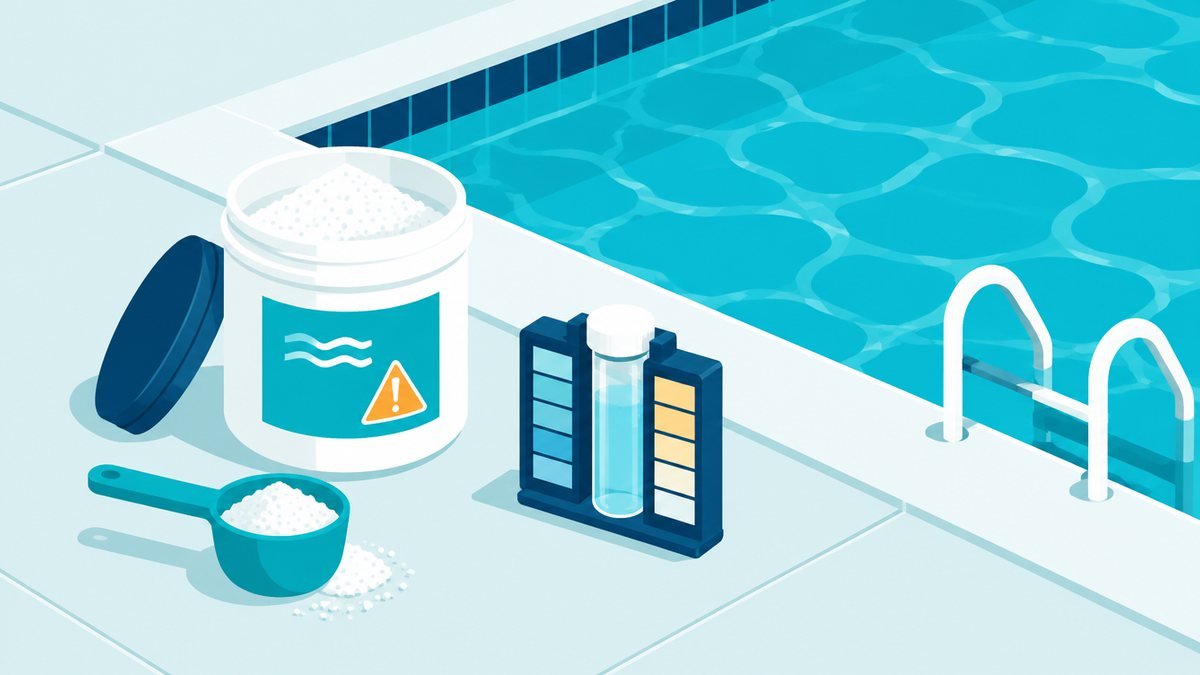
How to raise pH in pool water: test the water, check total alkalinity first, then add a pH increaser such as soda ash (sodium carbonate) in small amounts as the product label directs, run the pump and retest. If alkalinity is low too, correcting it usually brings the pH up with it, which is why alkalinity comes first. Low pH is common after heavy rain, after adding acidic chemicals or in pools with a lot of trichlor, and fixing it protects your equipment, your swimmers’ comfort and your chlorine’s effectiveness.
What is the right pH for a pool?
The CDC recommends keeping pool pH between 7.0 and 7.8. That range balances killing germs, the lifespan of the pipes and swimmers’ comfort. The CDC explains that as pH goes up, chlorine’s ability to kill germs goes down, especially above 8.0, and that as pH falls below 7.0, chlorine works better but pool and hot tub pipes are more likely to corrode.
Signs your pool pH is too low
- Eyes and skin sting more than usual.
- Chlorine disappears quickly.
- Metal fittings, ladders and heater parts corrode, or you see blue-green staining.
- Plaster surfaces or grout feel etched.
- The test kit shows a pH below 7.0 or a very light color on a pH test.
Never judge pH by eye. Test it.
How to test pH accurately
The CDC recommends a DPD test kit for the most accurate chlorine and pH results, and testing at least twice a day in a heavily used pool. For a normal home pool, test before you add anything and again after the water has circulated. Take the sample from elbow-deep in the water, away from returns, and read it in daylight. Our guide to pool water test kits compares the types.
How to raise pH in pool water, step by step
1. Check total alkalinity first
Total alkalinity is the water’s buffer against pH changes. Taylor Technologies lists 80 to 120 ppm as the ideal range, with 60 ppm as a minimum. They explain that sodium bicarbonate, the product that raises alkalinity, also raises pH slightly, while products that lower pH also lower alkalinity. If alkalinity is low, raise it first; see how to raise alkalinity in a pool.
2. Choose a pH increaser
Soda ash (sodium carbonate) raises pH most. Taylor’s chemistry reference lists it as the main way to raise pH, with a slight effect on alkalinity, and lists baking soda as having only a slight effect on pH. Buy a product made for pools and keep it in its original container.
3. Work out the amount from the label
The label gives a dose for a given volume of water, so you need to know your pool’s volume. Add less than the full amount, because it is easy to add more and hard to take it out. Follow the manufacturer’s instructions for how to measure, how to pre-dissolve it if directed and where to add it.
4. Add it safely, with the pump running
Wear gloves and eye protection, add chemical to water and not the other way round, and pour it slowly near a return jet or as the label directs. Don’t add other chemicals at the same time. Taylor warns that adding calcium chloride in the hours before or after soda ash or baking soda will make the water cloudy, so keep those treatments apart.

5. Wait, then retest
Let the pump run for several hours so the product circulates, then retest. Repeat in small steps if needed. Aim for the middle of the 7.0 to 7.8 range rather than the edge. Don’t swim until the chemicals have dispersed as the label directs.
Why pH keeps falling
- Low alkalinity. The pool has little buffer, so pH moves easily. Taylor calls this “pH bounce”.
- Acidic sanitizers. Some chlorine products, such as trichlor, are acidic.
- Rain and fill water. Rain is slightly acidic and can lower pH.
- Heavy bather use.
- Acid washing or over-treatment. Too much acid in an earlier step.
Fixing the underlying cause saves time and chemicals.
Raising pH is not the only fix
If pH is too high instead, see how to lower pH in a pool. If the water is cloudy as well as off in pH, read about cloudy pool water.
How to read your test results
| Reading | What it means | What to do |
|---|---|---|
| pH below 7.0 | Too low | Check alkalinity, then raise pH gradually |
| pH 7.0 to 7.8 | Inside the CDC’s recommended range | Leave it alone unless alkalinity is out |
| pH above 7.8 | Too high, and chlorine is less effective | See the guide to lowering pH |
| Alkalinity below about 80 ppm | Low | Raise alkalinity first |
| Alkalinity 80 to 120 ppm | Ideal, according to Taylor Technologies | Leave it alone |
Common mistakes when raising pH
- Adding a full dose at once instead of testing in steps.
- Adjusting pH before checking alkalinity.
- Adding chemicals without the pump running.
- Mixing a pH increaser with other chemicals in the same bucket.
- Retesting too soon, before the water has circulated.
- Using a test kit with expired reagents or a sample taken from the surface.
A routine that keeps pH steady
Test on a schedule, record the numbers and make one adjustment at a time. Keep alkalinity in range so pH stays put, rinse your test equipment, store reagents out of the sun and replace them as the maker advises. If pH keeps falling even with good alkalinity, look at the sanitizer you use and at rain and source-water effects.
When to ask a pool professional
Call a pool store or a service technician if pH won’t stay in range after you’ve corrected alkalinity, if you see staining or corrosion on metal parts, if the water is cloudy or green as well as off in pH, or if you’re unsure what product your pool needs. Take a fresh water sample in a clean bottle, taken from elbow depth, and ask for a full test, including total alkalinity, calcium hardness and cyanuric acid. A professional can also check your test kit and your equipment if the numbers don’t add up.
Remember that every pool is different. Pool surface, source water, sanitizer type and local weather all affect how pH moves, so use these steps as a framework and let your own test results guide each adjustment.
Frequently asked questions
What raises pH in a pool?
Soda ash (sodium carbonate) is the main pH increaser. Baking soda mostly raises alkalinity and affects pH only slightly.
Should I raise alkalinity or pH first?
Alkalinity first. It controls how stable your pH is, and raising it with sodium bicarbonate also raises pH a little.
How long after adding pH increaser can I swim?
Follow the product label, and swim only after the product has dispersed and the water tests in range.
Can I raise pH with baking soda?
Baking soda mainly raises alkalinity, with a slight effect on pH. If alkalinity is already in range, soda ash is the better choice.
Sources
Always check the manual for your exact model. These manufacturers and public agencies are good places to confirm the details that apply to your equipment.