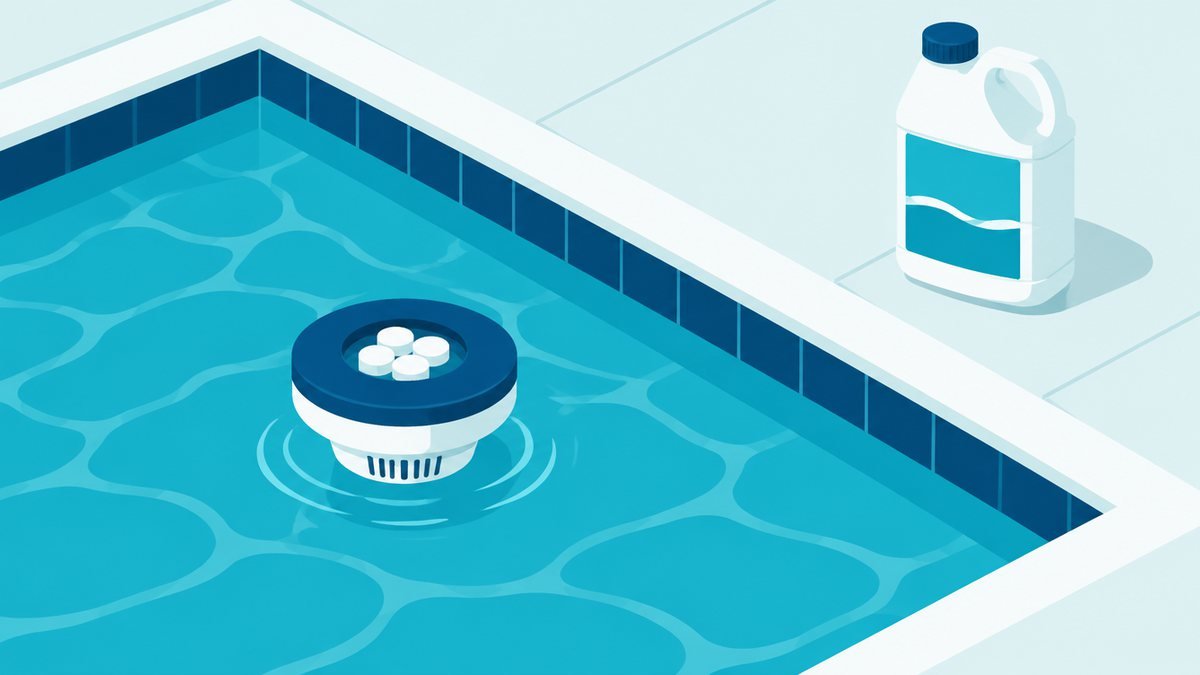
Chlorine tablets are slow-dissolving pucks that release chlorine into the water over several days, which makes them popular with owners who want steady sanitizer with little daily work. Liquid chlorine is the other common choice: it is added by pouring and acts quickly, but it is used up faster. Each has a place, and the right choice depends on your pool, your routine and how much you want to track other chemicals such as stabilizer. This guide explains how chlorine tablets work in pool maintenance, how they compare with liquid chlorine, how to use them safely and what mistakes to avoid.
What chlorine tablets are
Most pool tablets are trichlor, a stabilized chlorine compound pressed into large tablets. Because trichlor is stabilized, it contains cyanuric acid, which protects chlorine from being broken down by sunlight. The CDC refers to chlorine products with cyanuric acid, commonly known as dichlor or trichlor, and says to check the product label. It recommends a chlorine concentration of at least 2 ppm in pools that use cyanuric acid, compared with at least 1 ppm in pools that do not, and a pH of 7.0 to 7.8 in both cases.
For a quick top-up with liquid or granular chlorine instead of tablets, the pool chemical calculator converts the ppm change into an amount.
That cyanuric acid does not disappear. It builds up as you keep adding tablets, and the CDC notes that disinfection times are longer in the presence of cyanuric acid. This is the main reason to test the water regularly rather than assume tablets are enough on their own.
Chlorine tablets versus liquid chlorine
| Feature | Chlorine tablets | Liquid chlorine |
|---|---|---|
| Form | Slow-dissolving solid pucks | Liquid sodium hypochlorite |
| Speed | Slow and steady | Fast, raises the level quickly |
| Stabilizer | Contains cyanuric acid, so it builds up over time | Usually contains none, so you add stabilizer separately if you want it |
| Effort | Low, loaded into a feeder or floater | Higher, poured in as needed |
| Storage | Compact and long-lasting if kept dry | Bulky and loses strength with time and heat |
| Best for | Routine daily dosing | Quick corrections and pools that want no added stabilizer |
Many owners use both: tablets for the baseline and liquid for quick boosts, and they test often enough to keep cyanuric acid in range.

How to use chlorine tablets to sanitize a pool
- Test first. Check free chlorine, pH and alkalinity before you add anything. See pool water test kit for the kit types.
- Choose a feeder. Use a floating dispenser, an inline chlorinator or an off-line feeder, as the product label directs. Dropping tablets loose onto the pool floor or liner can bleach or damage the surface.
- Load the right amount. Follow the label for your pool volume. Start with fewer tablets and adjust after you test.
- Set the feeder or floater so water can flow past the tablets.
- Retest after a day or two and adjust the number of tablets or the feeder setting.
- Remove the floater when the pool is in use if the manufacturer advises it, and keep it out of swimmers’ way.
Where not to put tablets
- Loose in the skimmer. A tablet in the skimmer can send highly concentrated chlorine into the pump, filter and heater when the pump stops and starts. Many manufacturers advise against it, so check the manual for each piece of equipment.
- On the pool floor or the steps. The concentrated chlorine can damage liners and plaster.
- In a hot tub. The CDC recommends not using chlorine products with cyanuric acid in hot tubs. See hot tub chemicals for options.
- Near a heater. Concentrated chlorine can be hard on heater parts, and Hayward’s heater troubleshooting guide lists high sanitizer levels among the causes of heat exchanger damage.
Managing cyanuric acid when you use tablets
Cyanuric acid, also called stabilizer or conditioner, keeps chlorine from burning off in sunlight, but too much makes chlorine slow to disinfect. Test it from time to time, and if it gets high, partial draining and refilling is the common fix, since there is no everyday chemical that removes it. Our guide to how to lower pH in pool water covers the other balance adjustments you may need as you use tablets. Some tablet products also lower pH slightly as they dissolve, so watch pH as well as chlorine.
Choosing a tablet product
- Read the active ingredient. The label names the compound and its strength, so you know whether you are buying stabilized chlorine and what dose it expects.
- Match the size to your feeder. Large pucks fit most floaters and feeders, while small tablets suit small pools or spa-style feeders.
- Avoid multi-purpose claims you cannot verify. Tablets that add algae control or clarifier still need testing, and they do not replace brushing, filtering and balanced water.
- Buy for one season. Tablets last a long time when dry, but a fresh container is easier to trust than one that has been opened for years.
A simple tablet routine
- Test chlorine and pH at least a few times a week while the pool is in heavy use, and after storms.
- Brush the walls and floor weekly, because algae can start even when chlorine is present.
- Run the pump long enough each day that the feeder keeps delivering chlorine. A pump on a short timer may leave the tablets sitting dry or dosing unevenly. See pool pump timer.
- If the water turns hazy or green despite tablets, see cloudy pool water before adding more product.
When liquid chlorine is the better choice
- For a quick boost after heavy use, rain or algae.
- When cyanuric acid is already high and you want to avoid adding more.
- For small adjustments that a tablet cannot make precisely.
Pour liquid chlorine slowly into the water near a return with the pump running, away from the skimmer and walls, and never add it to a pool that already has another chemical in the same spot.
Frequently asked questions
How many chlorine tablets do I need for my pool?
It depends on the pool volume, the tablet size, the weather and how often people swim. Follow the label as a starting point, then adjust to test results.
Can I put chlorine tablets in the skimmer?
Most manuals advise against it because the concentrated chlorine can reach the pump, filter and heater. Use a floater or feeder.
Why is my chlorine low even though I use tablets?
Sunlight, heavy use, rain, a high pH or too much cyanuric acid can all hold chlorine back. Test the water and check each factor.
Are chlorine tablets safe for a salt water pool?
A salt system makes its own chlorine, so tablets are mostly used as a backup. Follow the salt system manufacturer’s advice.
Sources
These pages are worth reading in full if you want the details behind this guide.