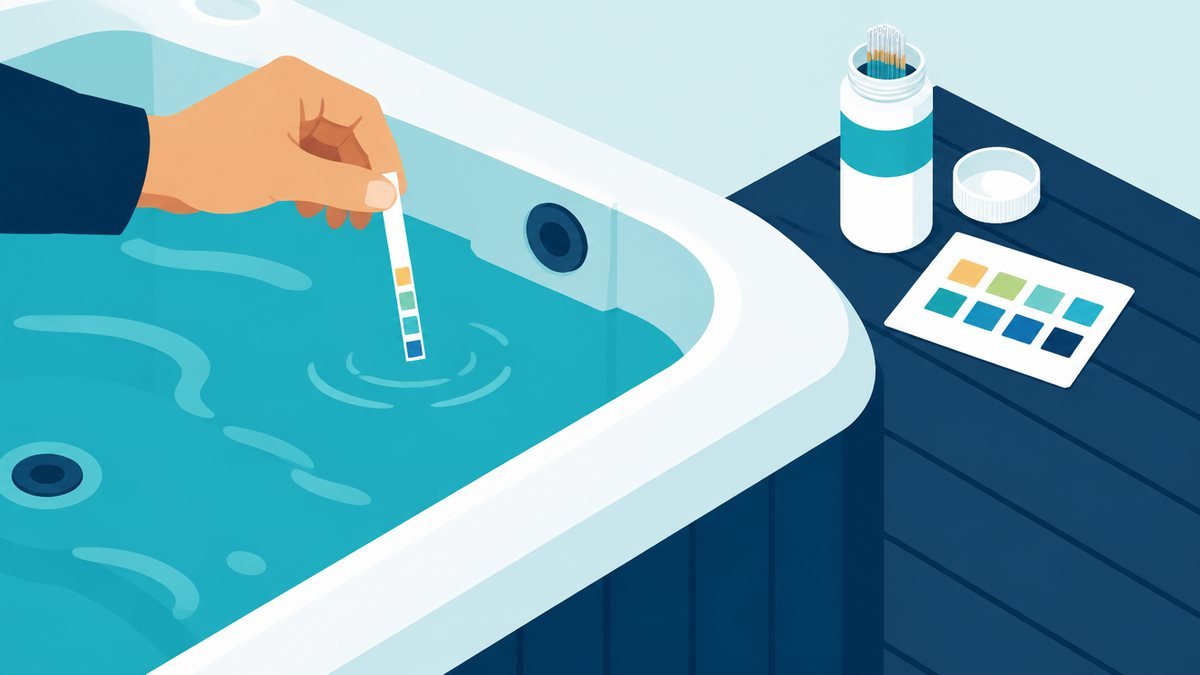
A hot tub water tester kit tells you what is actually in your water so you can add only what it needs. Small volumes of hot water change quickly, and a sanitizer level that was fine yesterday can be gone after one busy evening. The right kit depends on how often you test, how precise you want to be and how comfortable you are reading colors. This guide explains the main kit types, what to measure, how to test properly and how to read the results.
Why testing matters more in a hot tub
A hot tub holds a few hundred gallons at around 100 degrees Fahrenheit, with several people sharing it at once. The CDC says chlorine and pH are the first defense against germs, and that owners must routinely test and adjust both. It recommends a pH of 7.0 to 7.8 and a chlorine concentration of at least 3 ppm in hot tubs, and it recommends testing at least twice a day, and more often when many people use the tub. Jacuzzi’s maintenance guidance is simpler for everyday owners: test weekly for pH and alkalinity with strips, and always test before you add any chemical.
Types of hot tub water tester kit
| Kit type | How it works | Strengths | Limits |
|---|---|---|---|
| Test strips | Dip a strip, wait, and match the pads to a color chart | Fast, cheap and good for quick checks | Less accurate and easy to misread. Strips go bad if damp or old |
| Liquid drop kit (DPD) | Add reagent drops to a water sample and compare the color | More accurate for chlorine and pH | Takes longer, and reagents expire |
| Titration kit (FAS-DPD) | Count drops until a color changes | Gives a number rather than a color match | More steps and more practice needed |
| Digital meter or photometer | A device reads the sample and shows a value | Removes color judgment | Needs calibration, batteries and reagents |
The CDC says the most accurate results for chlorine and pH come from a DPD test kit, and that test strips are less accurate, though they can be used. Whatever you use, the CDC says to follow the manufacturer’s directions. See pool water test kit for the same comparison in a larger pool.

What a good kit should measure
- Sanitizer. Free chlorine or bromine, matching what your tub uses.
- pH. Affects comfort and how well sanitizer works.
- Total alkalinity. Stabilizes pH. Taylor Technologies gives an ideal range of 80 to 120 ppm for pools, and Jacuzzi suggests 100 to 150 ppm in its maintenance guidance for hot tubs, so use the range in your manual.
- Calcium hardness. Jacuzzi’s maintenance tips mention 175 to 275 ppm for hot tubs. Too low can corrode, and too high can form scale.
- Optional extras. Some kits test cyanuric acid, which the CDC says not to use in hot tubs, and some add tests for salt or metals if you use a salt system or have high-iron fill water.
How to test your hot tub water
- Wash your hands and dry them. Oils and chemicals on your fingers can change the result.
- Take a sample from about elbow depth, away from jets and skimmers, so you test the water, not the surface film.
- Test promptly. Don’t let the sample sit, and test in good light.
- Follow the timing on the instructions. Reading a strip too soon or too late changes the color.
- Record the numbers. A small log shows trends before they become problems.
- Adjust one thing at a time, circulate, then retest.
Getting accurate readings
- Store strips and reagents in a cool, dry, shaded place with the cap closed tightly. Check expiry dates.
- Rinse vials with sample water before use, and don’t touch reagent droppers to the sample.
- Watch for bleaching. The CDC notes that if chlorine is above 10 ppm, the test might bleach out and show a false low or zero reading. If you’ve just added a large dose, wait before you trust a zero.
- Compare in the same light each time. Daylight shifts colors.
- Take your sample to a dealer now and then. Some dealers will test a sample of your fill water for metals, phosphates and calcium, which many home kits don’t cover.
How often to test
| Situation | Suggested testing |
|---|---|
| Heavy use or a party | Before and after, and the CDC says more often when many people use the tub |
| Normal weekly use | Check sanitizer and pH before each soak, and test alkalinity weekly |
| After refilling or adding chemicals | Test before and after, once the water has circulated |
| Unused for a while | Test and rebalance before use |
For a full routine, see hot tub maintenance. If your readings look fine but the water is hazy, read cloudy hot tub water.
Common mistakes with strips and drops
- Dipping and swishing. Most strips should be dipped briefly and held level, not swirled, unless the instructions say so.
- Shaking off water. Doing it differently from the instructions can blend neighboring pads and shift the colors.
- Counting drops loosely. Hold droppers upright and add drops one at a time, so each one is the same size.
- Testing right after adding chemicals. Let the water circulate first, or the reading will reflect a pocket of product rather than the whole tub.
- Using old reagents. Liquids and strips lose strength over time, so replace them when they pass their date.
Choosing a kit
For most owners, a good strip kit for quick daily checks plus a DPD drop kit for confirming chlorine and pH is a sensible pair. Choose a kit that matches your sanitizer, tests the ranges your manual uses and has clear instructions. If a kit gives a color chart with no numbers or ranges, you will struggle to act on the result.
Frequently asked questions
Are test strips accurate enough for a hot tub?
They are fine for quick checks. The CDC says they are less accurate than a DPD test kit, so confirm with drops when a reading looks odd.
How often should I test my hot tub water?
The CDC recommends testing chlorine and pH at least twice a day, and more often when the tub is busy. Many home owners test before each soak.
Do I need a different kit for a salt water hot tub?
You still test sanitizer, pH and alkalinity, and you also need a way to check the salt level. See u003ca href=u0022/salt-water-hot-tub/u0022u003esalt water hot tubu003c/au003e.
Why does my chlorine test show zero after shocking?
A very high chlorine level can bleach the reagent and read as zero. Wait for the level to drop and retest.
Sources
The references below are good places to confirm the details on this topic.