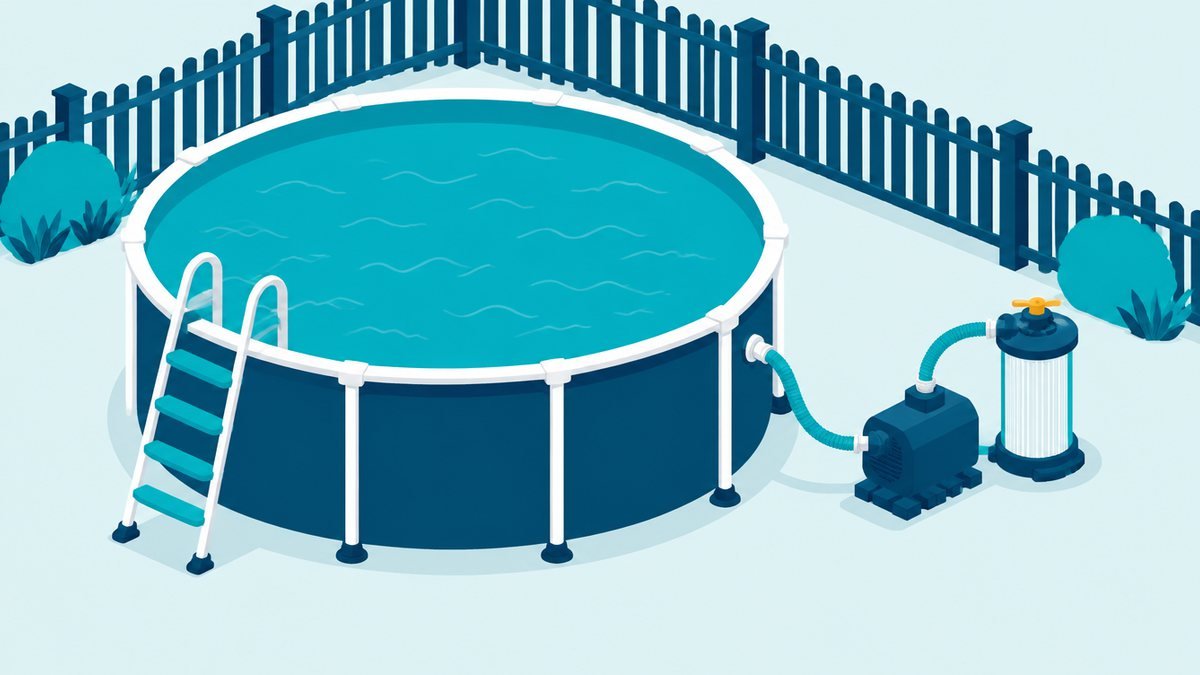
An above ground pool pump circulates the water through the filter so the pool stays clear, and choosing the right above ground pool pump comes down to matching the pump’s flow to your pool, your filter and your plumbing. Too small a pump leaves the water stagnant, while one that is too big for the filter can push water through faster than the filter can clean it. Above ground pools also use smaller plumbing and often come as a pump and filter set, which changes how you compare options. This guide explains the types of pump, how to choose one and how to keep it running well.
How an above ground pool pump works
Water enters the pump through the skimmer or suction line and flows into a strainer basket that catches leaves and debris. A motor turns an impeller that pushes the water through the filter and back to the pool through return fittings. A self-priming pump can start with some air in the line, as long as the strainer housing holds water. Hayward’s manual for its self-priming pumps says to fill the strainer housing with water before starting and never to run the pump dry, because water cools and lubricates the shaft seal.
The pool pump size calculator gives the flow, run time and a filter and pipe check for your pool.

Types of above ground pool pump
| Type | How it runs | Strengths | Trade-offs |
|---|---|---|---|
| Single-speed | One fixed speed | Lowest price and simple | Uses the most electricity and runs at full speed every time |
| Dual-speed | High and low speeds | Low speed for daily filtration, high speed for vacuuming | Needs a compatible control or switch |
| Variable-speed | Adjustable speed | Quiet and efficient | Higher up-front cost |
Our guide to the variable speed pool pump explains how speed control works. ENERGY STAR notes that running a pool pump at half speed uses about one eighth of the energy of full speed, so adjustable speed can reduce the cost of circulation. The U.S. Department of Energy’s measure guideline for replacing single-speed pumps explains the same effect, called the affinity law.
How to size an above ground pool pump
- Find the pool volume. It depends on the diameter or length, width and average depth. Use the manufacturer’s volume figure if you have it.
- Decide how often you want the water turned over. A common goal is to circulate the full volume at least once a day. Your pump and filter manual give the flow rates.
- Match the flow to your filter. The filter has a maximum flow rating. A pump that moves more water than the filter can handle reduces filtering and may damage the filter.
- Check the plumbing. Above ground pools typically use 1.5 inch hoses or pipe, and the pump’s ports must match your hoses or fittings.
- Check the electrical supply. Confirm the voltage and plug type for the pump and that the circuit is protected by a ground-fault circuit interrupter.
Pump sizing is about flow and head, not only horsepower. Compare the flow at your pool’s resistance, which the manufacturer’s performance chart shows, rather than only the horsepower number.
Pump and filter pairing
An above ground pool pump pairs with a sand, cartridge or DE filter, and each has a flow limit. See our guides on the pool sand filter and the pool filter cartridge for how to match them. If the pressure gauge on your filter climbs quickly or the flow is weak, the filter may need cleaning before you replace the pump.
Installing the pump
- Set the pump on a firm, level pad, protected from flooding, with the pool water level above the pump inlet if possible.
- Use PTFE tape on threaded plastic connections. Hayward warns against pipe dope on molded plastic parts, because it can cause cracking.
- Keep suction hoses short and straight, and keep the connections tight, because air leaks cause priming trouble and noise.
- Open all valves before you start the pump, and let the water fill the strainer first.
- Do not stand over the pump or filter when you start it. Hayward’s manual says to stand well back when starting a pump after service.
Choosing between a pump alone and a pump and filter set
Many above ground pools ship with a matched pump and filter set, and for a small pool that is usually enough. The set is sized so the pump’s flow stays below the filter’s rating, and the hoses and fittings fit together. If you replace only the pump later, take the model number of the filter with you and compare the ratings. A stronger pump on an old, small filter may not clean any better, and it can wear the filter faster. When the old pump still turns but the water stays cloudy, check the filter media, the baskets and the chemistry before you spend money on a new motor.
Pump size starts with pool volume, which the pool volume calculator works out for round, oval and rectangular pools.
Saving energy
- Run the pump only as long as you need to circulate the volume, often six to eight hours, and test the clarity before you shorten the time.
- Use a timer. See our guide on the pool pump timer.
- Keep the baskets, filter and hoses clean so the pump does not work against resistance.
- ENERGY STAR and DOE both note that reducing the speed saves a lot of energy because the power needed falls much faster than the flow does.
Common above ground pool pump problems
- Pump won’t prime. Check the water in the strainer housing, the lid O-ring and the suction connections. Hayward’s manual says any self-priming pump will not prime if there are suction air leaks.
- Weak flow. A full basket, a dirty filter, a closed valve or an air leak are the usual causes.
- Noisy pump. Air in the line, low water level and worn bearings can all cause it.
- Motor hums but won’t start. A jammed impeller or a failing capacitor may be the cause, and a technician should look at it.
If a problem continues, see pool pump repair.
Frequently asked questions
What size pump do I need for an above ground pool?
Choose one that can turn the pool volume over about once a day at the flow rate your filter supports, using the manufacturer’s performance chart.
Can I use an inground pool pump on an above ground pool?
Sometimes, but inground pumps are often larger than above ground filters and plumbing can handle. Match the flow to the filter and the hoses.
How long should I run my above ground pool pump?
Long enough to circulate the whole volume at least once a day and keep the water clear. Many owners run it for several hours and adjust after testing.
Do I need a variable-speed pump?
No, but it saves energy and runs more quietly, so it is worth considering if you run the pump many hours a day.
Sources
Manufacturers update their instructions from time to time, so confirm anything model-specific in your current manual. Sources used here: