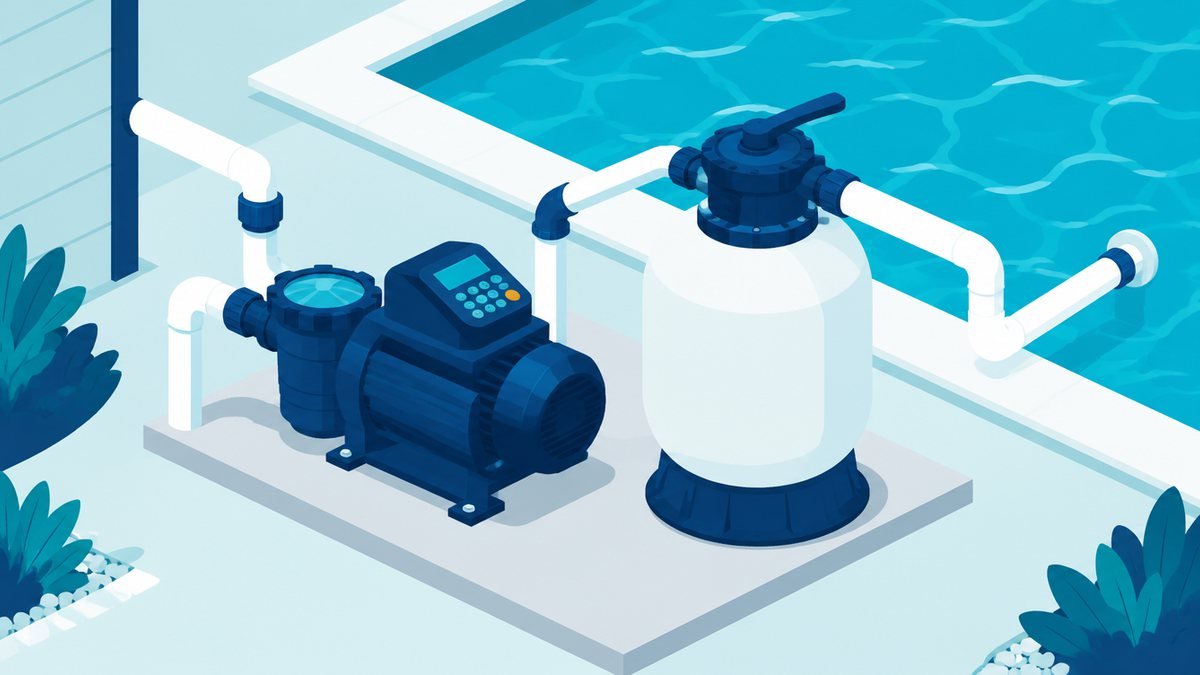
A variable speed pool pump lets you run the pump slowly for long periods instead of fast for short ones, and that is where the savings come from. ENERGY STAR explains that reducing pump speed by one-half allows a pump to use just one-eighth as much energy, because filtering needs only about half the flow of running a pool cleaner. This guide explains how a variable speed pool pump works, how it compares with single-speed and two-speed pumps, how to set one up and what to check before you buy.
How a variable speed pool pump works
A conventional pump runs at one speed, usually fast, whatever the job. A variable speed pump has a motor controller that lets you choose speeds, usually on a keypad on the pump or from an automation system. You set a low speed for everyday filtering, and higher speeds for jobs that need more flow: running a cleaner, a waterfall, a spa or backwashing. The U.S. Department of Energy’s pool pump guide sums up the idea as “run it slower and run it longer.”
To see what flow your pool needs, try the pool pump size calculator. It gives the gpm for a turnover time you choose.
Single-speed, two-speed and variable speed compared
| Pump type | Speeds | How it saves energy | Things to consider |
|---|---|---|---|
| Single-speed | One, usually fast | Only by running fewer hours | Simple and common, but wastes energy at cleaner speeds during filtration |
| Two-speed | High and low | Runs low most of the time | Only two choices, and some run too low for some equipment |
| Variable speed | Many, set on a keypad | Matches speed to each job | Needs programming, and it should be compatible with your heater, cleaner and controls |
How much can you save?
ENERGY STAR says certified in-ground pool pumps use 20 percent less energy than standard pool pumps, and it says running a filter for 6 hours a day instead of 24 would reduce energy use by 75 percent. DOE’s guide explains that most of the saving comes from the pump affinity law: a small drop in flow cuts the power demand by a lot. Your own result depends on your current pump, how long you run it and your electricity rates, so treat any figure as a guide.
How to set up a variable speed pump
1. Know your pool’s turnover target
Work out the volume of water and how long you need to turn it over. DOE’s guide notes that the Association of Pool and Spa Professionals has suggested a pump be capable of turning over the whole pool twice in 24 hours, but that actual turnover can be slower when conditions allow. Our guide to the pool pump timer explains how to work out run time.
2. Set a low speed for daily filtering
ENERGY STAR recommends the lowest speed that still gives adequate circulation. Check that the flow still meets the minimum needs of your filter, heater and sanitizer. A heater can fail to fire at too low a flow, so see our guide to pool heater repair if it won’t start after you lower the speed.
3. Add higher speeds for specific jobs
Use a higher speed for a cleaner, a waterfall or backwashing, and for priming after a restart. Most pumps let you save several preset speeds and schedule them.

4. Schedule it
Use the pump’s built-in schedule, or an automation system. Run the low speed long enough to filter the water properly, and use short, faster cycles if debris is a problem.
5. Watch the water, not just the numbers
If the water stays clear and the filter pressure is steady, your setting is working. If it turns cloudy or the filter clogs faster, raise the run time or the speed a little.
What to check before you buy
- Whether the pump is ENERGY STAR certified for your pool type.
- Compatibility with your heater, cleaner, salt system and automation.
- The size of your plumbing, since a pump can only move so much water through narrow pipes.
- The control interface and whether the schedule can be set easily.
- The warranty and local support.
- Any utility rebate. ENERGY STAR notes that many utilities offer incentives for certified pumps.
Troubleshooting a variable speed pump
- Loses prime at low speed: raise the speed or check for air leaks. See pool pump repair.
- Heater won’t fire: flow is too low, so increase the speed during heating.
- Fault codes: use the pump’s manual, and call a technician if they persist.
- Cleaner stops: it may need a higher speed.
If you have an above ground pool, see above ground pool pumps, and for solar options see solar pool pumps.
Energy use in plain terms
A pump’s electricity use depends on how much power it draws and how long it runs. A single-speed pump runs at one power level, so cutting hours is the main saving. A variable speed pump lets you cut both, because slower speeds draw far less power and run for longer. ENERGY STAR notes that a pump can cost as much as $310 a year in energy at the upper end, which is why the choice of pump and the schedule matter. Compare your own electric bill before and after you change the schedule.
Common setup mistakes
- Setting the speed too low, so the filter and heater don’t get enough flow.
- Leaving the pump on its factory schedule without checking that it suits your pool.
- Forgetting to raise the speed for a cleaner or a waterfall.
- Ignoring the filter pressure. If it rises faster than before, increase the run time.
- Not priming properly after a restart, and then blaming the pump.
- Mixing up the pump’s preset speeds and the automation system’s schedule, so they fight each other.
Pairing the pump with the right filter and plumbing
A pump delivers flow, but the filter and pipes decide how much of it gets through. A dirty filter or undersized plumbing raises resistance, and the pump has to work harder. A clean filter, smooth plumbing with few tight elbows and correctly sized pipes let you run slower. Check the filter’s pressure and flow range in its manual, and don’t push more flow through it than it is rated for.
Cost, rebates and when to replace
A variable speed pump costs more up front than a single-speed one, and the saving builds up as you run it. ENERGY STAR notes that many utilities offer rebates for certified pumps, so check with yours before you buy. Replace a pump when it is failing, noisy or leaking, and consider a variable speed model at that point. See our guide on pool pump replacement for what to look for.
Frequently asked questions
Is a variable speed pool pump worth it?
It often is, because running slower uses much less energy. Your savings depend on your current pump, run time and electricity rates.
Can a variable speed pump replace any pump?
Usually, if the connections and electrical supply match, but check compatibility and plumbing size, and have the work done by a professional.
What speed should I run my pump?
The lowest speed that still gives adequate circulation and clear water, with higher speeds only for jobs that need them.
Does a variable speed pump work with a heater?
Yes, but the heater needs a minimum flow, so set a speed that meets it while the heater runs.
Sources
These public agencies publish guidance that is a good place to confirm the details on this topic.