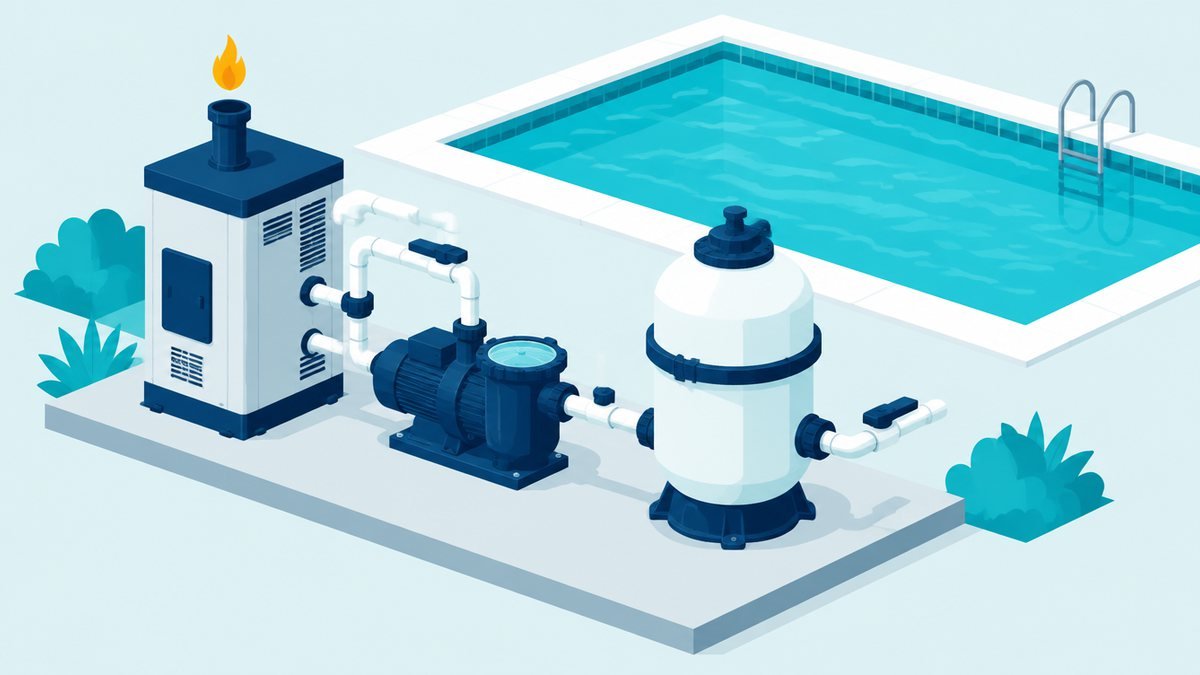
Pool heater repair usually begins with water flow, not with the heater itself. A gas heater or heat pump will not run unless a flow or pressure switch proves that water is moving through it, so a dirty filter, a closed valve, a pump that is off or a bypass left open are the most common reasons a heater won’t heat. This guide explains what to check, what the error codes mean and why the work inside a heater belongs to a licensed technician.
How a pool heater decides to heat
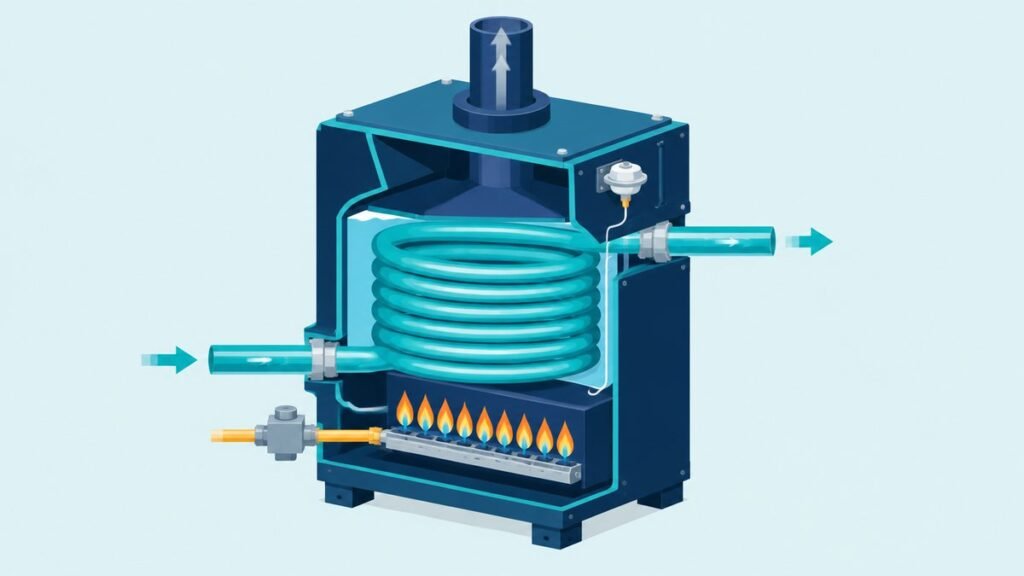
Pool water is pumped through the filter and then through the heater. The heater compares the water temperature with the set point. When it is below it, a gas heater starts a sequence: Hayward’s guide for its Universal H heaters describes a blower purge, then ignitor warm-up, then a short trial for ignition, with the gas valve opening only when the safety switches confirm it is safe. The water pressure switch (or flow switch) is one of those safety checks. If the switch doesn’t see enough water flow, the heater stays off.
A heat pump works on the same principle: it needs water flow before it will run, and Hayward’s heat pump guide says the most common cause of a flow-related error code is low or no water flow.
Pool heater repair: check these first
1. Is the pump running and the filter clean?
Hayward’s heat pump guide says open bypass valves, a time clock in its off cycle, a pump that is turned off and a dirty filter account for the majority of flow and pressure-switch errors. Check that the pump is on and primed, and that the filter pressure isn’t high. See our pool sand filter guide and how to backwash a pool filter if the filter needs attention.
2. Are the valves in the right position?
Make sure the valves feeding the heater are open and any bypass is set so water actually flows through the heater. A bypass that pressurizes the heater without sending water through it can leave the switch open.
3. Is the thermostat set to call for heat?
Confirm the set point is above the current water temperature and that the heater is not in standby or a lock-out. Some heaters have a temperature lock-out that stops the setting rising above a limit.
4. Read the display code
Heater displays show codes. Codes differ by brand and model, so use the table in your manual, and write the code down before you reset the heater. Hayward’s Universal H guide, for example, lists these:
| Code | Meaning (Hayward Universal H) |
|---|---|
| IF | Ignition failure |
| AO / AC | Blower vacuum switch open / closed |
| LO | Water pressure, vent pressure or temperature limit switch fault |
| HS | Maximum return water temperature exceeded, or rapid rise |
| SF | Temperature sensor (thermistor) input failure |
5. Is there gas or power?
For a gas heater, check that the gas supply is on and the tank (for propane) isn’t empty. For an electric supply, check the breaker. Don’t go further than this.
Flow: the hidden cause
Heaters need the right amount of flow. Hayward’s guide warns never to run a heater below its minimum flow, because the heater can dry-fire or the water can boil and trip the high limits, and that flow above the maximum can damage the heat exchanger. The internal bypass should be inspected periodically, since it can be the cause of low or high flow through the exchanger. Both a weak pump and a pump that is too big can cause trouble, so confirm the heater model’s required flow in its manual.
Heater tries to light and fails
Hayward’s guide describes what a gas heater does after a failed ignition trial: it purges, retries up to three times and then locks out with an IF code. It waits about an hour and tries again, and keeps retrying while there is a call for heat. A heater that clicks and then stops is telling you the ignition or flame-sensing system has a problem, or that gas isn’t reaching the burner.
What a technician will check
A service technician tests the pressure or flow switch for continuity with the pump running, checks wiring and connectors, inspects the heat exchanger and burner, checks the gas pressure and tests the control board and sensors. These tests need a meter and training, and some involve live voltage or gas.
Keep a heater out of trouble
- Keep the filter clean and the pump basket empty.
- Keep the water chemistry in range. Keep the water chemistry in range. The CDC says water with a pH below 7.0 makes pool pipes more likely to corrode.
- Keep the area around a gas heater clear of leaves, boxes and stored items.
- Have the heater inspected on the schedule in its manual.
- Close the heater properly for winter. See how to close a pool for winter.
To compare heater types, read about how a gas pool heater works and pool heat pumps.
Heat pump or gas heater: what changes
A gas heater adds a gas supply, a blower, an ignitor and flame sensing, so its error codes often point to ignition or venting. A heat pump moves heat from the air into the water, so it needs airflow around the unit as well as water flow, and its guide refers to refrigerant, which only certified technicians may handle. Hayward’s heat pump guide covers refrigerant and says the work is for qualified servicers. Both need water flow first, which is why the pump, filter and valves come first in every troubleshooting order.
Won’t turn on, or turns on but won’t heat?
These are different problems. A heater that won’t start at all points to power, a lock-out, a tripped switch or a control fault. A heater that runs but doesn’t warm the water points to a heater that is too small for the conditions, a bypass sending water around the heat exchanger, a thermostat or sensor reading wrongly, or cycling on and off because of a limit switch. A cover that is left off in cool weather can also undo the heater’s work, because most of a pool’s heat loss is at the surface.
Information to have ready before you call
Have the heater’s make, model and serial number, the exact code and when it appears, what you have already checked and how the heater behaved before the problem.
Frequently asked questions
Why is my pool heater running but the water isn’t getting warm?
Common causes are the heater cycling off on a flow or limit switch, a bypass setting that sends too little water through it, or simply a heater too small for the weather and the pool’s heat loss. Check the display for a code.
What does a pressure switch do on a pool heater?
It proves water is flowing before the heater is allowed to fire. If it doesn’t close, usually because of low flow, the heater stays off.
Can I reset a pool heater that has locked out?
You can usually cycle power or reset the control as the manual describes, but if it locks out repeatedly, find the cause instead.
Is it safe to repair a gas pool heater myself?
Basic checks such as the pump, filter, valves and settings are fine. Work inside the heater involves gas and voltage, and manufacturers say qualified technicians should do it.
Sources
Always check the manual for your exact model. These manufacturers are good places to confirm the details that apply to your equipment.