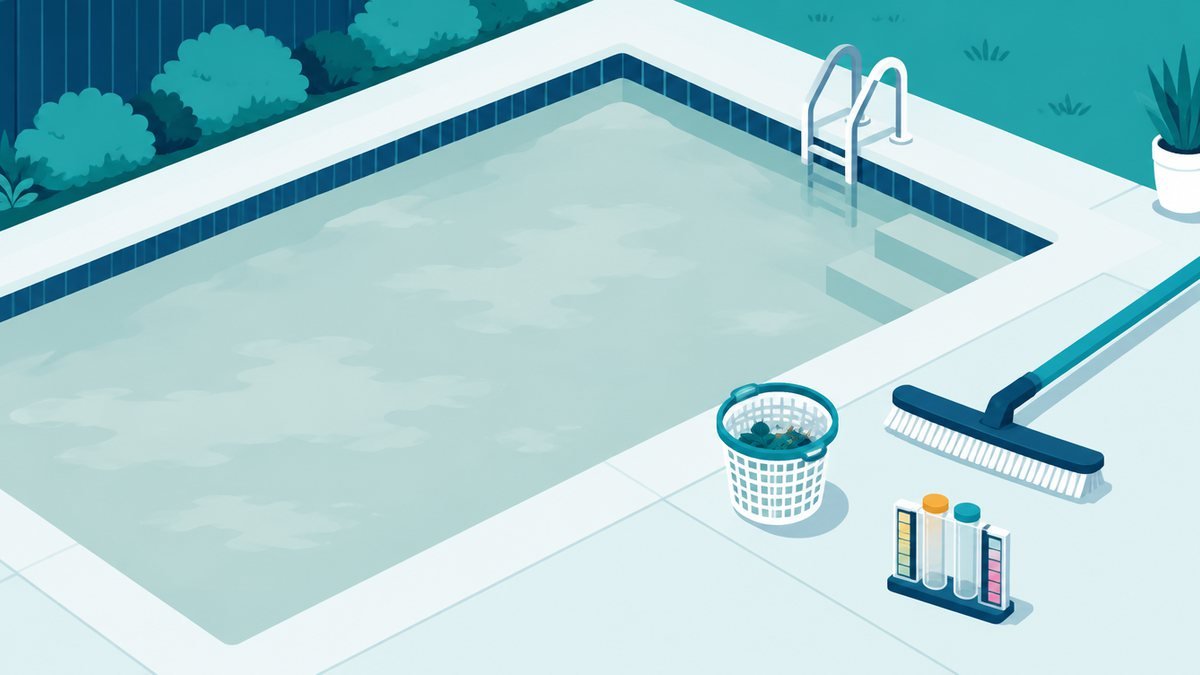
Cloudy pool water almost always comes down to one of three things: not enough filtration, water chemistry that is out of range, or fine particles that the filter can’t catch. Find which one you have, fix it in that order, and the water clears without any guesswork. Starting with a test kit and a look at the filter solves more cases than any chemical, and the wrong chemical added in a hurry often makes cloudiness worse.
Why a pool turns cloudy
- Poor filtration. The filter is dirty, the sand is worn, the pump runs too few hours or the water isn’t circulating to every corner.
- Low sanitizer. Chlorine is used up, so tiny algae and bacteria multiply. The CDC recommends at least 1 ppm of free chlorine in a pool, or at least 2 ppm if you use cyanuric acid.
- pH or alkalinity out of range. The CDC recommends a pH of 7.0 to 7.8. Taylor Technologies gives 80 to 120 ppm as the ideal total alkalinity. Out-of-range water makes chlorine less effective and can make minerals precipitate.
- Scaling or very hard water. If the cause isn’t obvious, test calcium hardness too, because hard water can cloud when pH and alkalinity drift upward.
- Heavy use or weather. Swimmers, sunscreen, pollen, storms and runoff all add particles and use up chlorine.
- A new fill or chemical addition. Some products cloud water briefly.
How to fix cloudy pool water, step by step
1. Test the water properly
The CDC recommends testing chlorine and pH at least twice a day in a pool or hot tub that is heavily used, and using a DPD test kit for the most accurate results. Test free chlorine, pH and total alkalinity first. Write down the numbers.
2. Fix pH and alkalinity before anything else
Chlorine works best when pH is in range. Our guide to how to raise pH in pool water explains the steps, and the order matters: adjust alkalinity first, then pH, and retest after circulation.
3. Restore sanitizer
If free chlorine is low, shock the pool following the product label. Never mix products, and add chemicals with the pump running. See our guide on how to shock a pool for when and how.
4. Clean the filter and run the pump
A filter that is overdue for cleaning can’t catch fine particles. For a sand filter, Pentair’s Triton manual says to backwash when the pressure gauge reads 10 PSI above its clean reading, for about 3 to 5 minutes or until the backwash water runs clean. For a cartridge or DE filter, follow the manual for cleaning. Then run the pump long enough to turn the water over several times. Our guides to the pool sand filter and pool pump timer explain how long to run it.
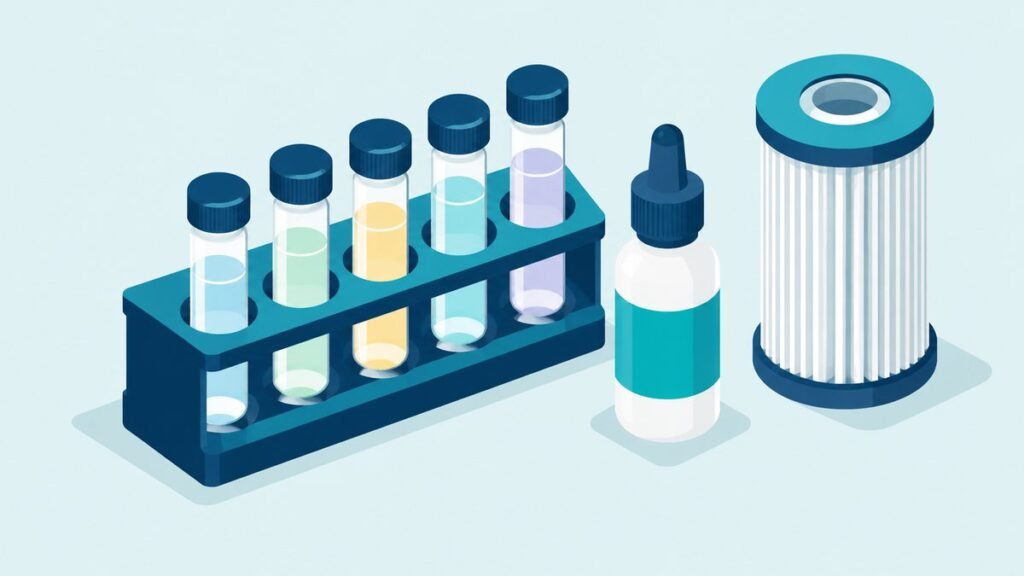
5. Brush, vacuum and skim
Brush walls and floors so particles reach the filter, vacuum debris and empty baskets. Remove leaves and dead algae.
6. Consider a clarifier or flocculant if the water is still hazy
When the chemistry is right and the filter is working but the water is still dull, a clarifier can help the filter catch very fine particles. Follow the label closely and run the pump as it says. A clarifier is a finishing step, not a substitute for the steps above.
How long does it take to clear?
It depends on what caused it and how long the filter runs. Light cloudiness often clears within a day or two once chemistry is right and the filter is running. Heavy cloudiness or a developing algae problem takes longer. If you can’t see the bottom drain, don’t swim, and treat the pool as unsafe until it clears.
When to suspect something else
If chemistry tests perfectly and the filter is clean but the water stays cloudy, look at the equipment: a cracked lateral or worn sand, a damaged cartridge, a pump that is losing prime or a suction leak. Persistent hazy water with a high filter pressure can also mean the filter needs a chemical clean.
Prevent cloudy water
- Test regularly and keep the numbers in range.
- Run the pump on a sensible schedule.
- Keep the filter clean and the baskets empty.
- Shower before swimming and keep debris out of the water.
- Cover the pool when it isn’t in use.
Cloudy water or green water?
Cloudy water is milky or hazy, and you can usually still see color in the water. Green water means algae are growing, and it needs a different, stronger treatment. If the cloudiness has a green tint, or the walls feel slimy, treat it as an algae problem and read our guide to a green pool instead.
A quick test checklist
| What to check | Target | Source |
|---|---|---|
| Free chlorine | At least 1 ppm (2 ppm with cyanuric acid) | CDC |
| pH | 7.0 to 7.8 | CDC |
| Total alkalinity | 80 to 120 ppm is ideal | Taylor Technologies |
| Filter pressure | Not higher than your clean reading after backwashing | Your filter manual |
| Pump run time | Long enough to filter the whole pool, with no cloudy days | Your own results |
Filter problems that look like chemistry problems
Sometimes the water chemistry is perfect and the pool stays hazy because the filter isn’t doing its job. A sand bed that has worn out, a cartridge with torn pleats, a lateral that has cracked or a valve that is leaking water past the sand will all let fine particles back into the pool. If the pressure never drops after backwashing, or water returns cloudy straight from the returns, have the filter inspected before you spend more on chemicals.
What not to do when the water is cloudy
- Don’t add several chemicals at once to “see what works”. You won’t know which fixed it, and some combinations are dangerous.
- Don’t backwash over and over. Pentair’s manual warns that backwashing too often leads to poor filtration.
- Don’t drain and refill the pool unless a professional advises it. It wastes water and doesn’t fix a filtration or chemistry problem.
- Don’t swim in water you can’t see through.
- Don’t ignore the filter pressure gauge. It tells you more than the color of the water.
If you work through the checklist and the water still won’t clear after a week, take a water sample to a pool store for a full test, and ask a pool professional to inspect the filter and pump.
Frequently asked questions
Why is my pool cloudy after shocking it?
It’s common for a shocked pool to look hazy while the chlorine breaks down particles and the filter catches them. Keep the pump running, keep the filter clean and retest.
Should I backwash a pool filter when the water is cloudy?
Check the pressure gauge. Backwash a sand filter when the pressure is 10 PSI above its clean reading, as the manufacturer advises, not on a fixed schedule.
Can I swim in a cloudy pool?
It’s best not to. Cloudy water can hide hazards and may mean the sanitizer isn’t keeping up. Wait until it is clear and tested.
Will a clarifier fix cloudy water on its own?
Not if the real cause is poor chemistry or filtration. Fix those first.
Sources
Always check the manual for your exact model. These manufacturers and public agencies are good places to confirm the details that apply to your equipment.