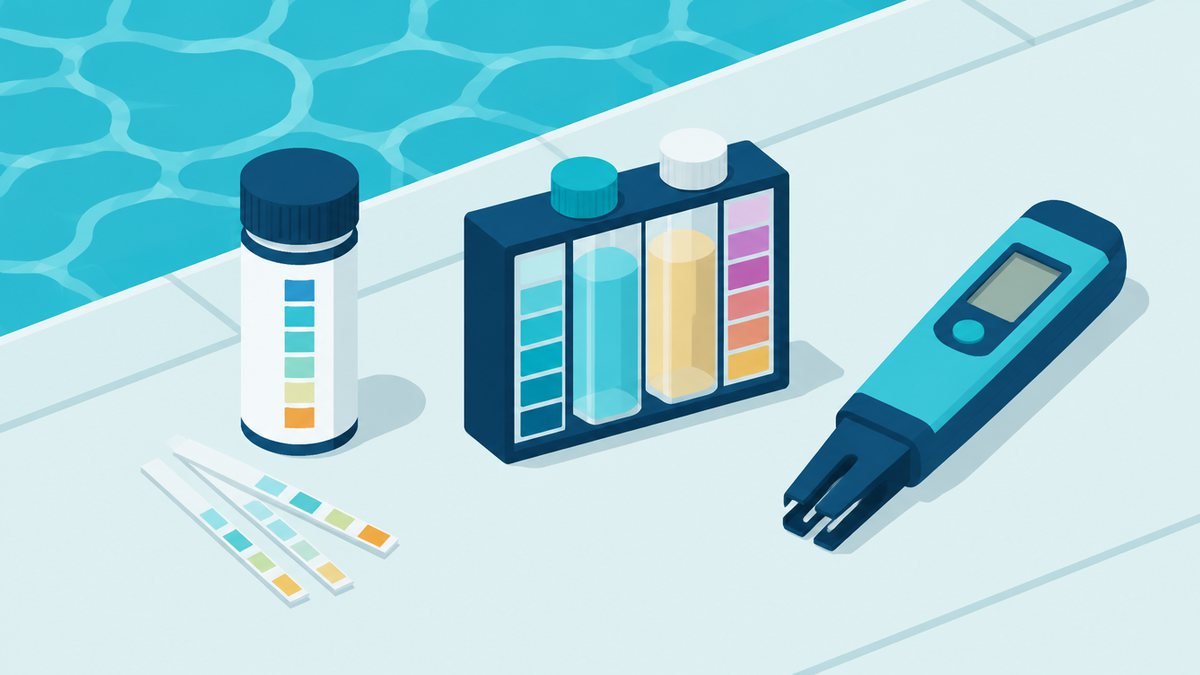
A pool water test kit is the tool that turns guesswork into a plan, because chlorine, pH and alkalinity cannot be judged by looking at the water. Kits range from simple strips to drop-based tests and digital meters, and each type trades speed against accuracy and cost. The right pool water test kit for you depends on how often you test, how precise you need to be and what sanitizer your pool uses. This guide compares the main kit types, explains what each can and cannot measure and shows how to choose and use one.
What a pool water test kit should measure
At a minimum, a kit should measure free chlorine (or bromine), pH and total alkalinity. The CDC recommends a pH of 7.0 to 7.8 and a free chlorine concentration of at least 1 ppm in pools, or at least 2 ppm in pools that use cyanuric acid. Taylor Technologies gives an ideal total alkalinity range of 80 to 120 ppm for pools, with a minimum of 60 and a maximum of 180. Good kits also cover calcium hardness and cyanuric acid, and salt pools need a salt test too.
Pool water test kits compared
| Kit type | How it works | Good for | Limits |
|---|---|---|---|
| Test strips | Dip, wait and match the pads to a color chart | Fast checks and beginners | The CDC says they are less accurate than a DPD kit, and color matching is subjective |
| Liquid DPD drop kit | Add reagent to a sample and compare to a color standard | Everyday accuracy for chlorine and pH | Takes longer, and reagents expire |
| Titration kit (FAS-DPD) | Count drops until a color changes, then read a number | Precise chlorine readings at higher levels | More steps, and practice is needed |
| Digital meter or photometer | A device reads the color or electrical signal | Removes color judgment | Needs calibration, batteries and reagents |
| Pool store lab test | Staff test a sample you bring | Metals, phosphates and total dissolved solids | Not immediate, and the result depends on how you collected the sample |
The CDC says the most accurate results for chlorine and pH come from a DPD test kit, and it also warns that if the chlorine in a sample is more than 10 ppm, the test might bleach out and show a false low or zero reading. Many owners keep strips for quick daily checks and use a drop kit when a reading looks wrong. See pool water test strips for how to read strips and where they fall short.
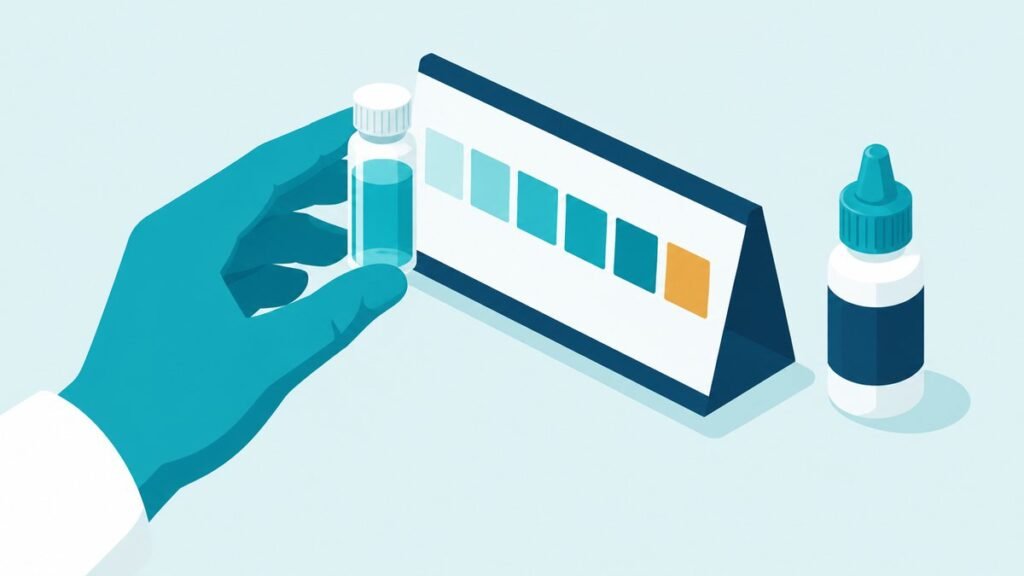
How to choose a pool water test kit
- Match the sanitizer. Some kits are for chlorine only, and others cover bromine or salt systems.
- Check the range. A kit that stops at a low maximum may not read a pool that has been shocked.
- Look at the parameters. Is cyanuric acid included? Does the kit measure calcium hardness and total alkalinity?
- Check the readability. Clear color charts or numbered scales matter more than a long list of tests.
- Look at the shelf life. Reagents and strips have expiry dates, and a kit that you use slowly may expire before it is used up.
- Compare refill costs. A cheap kit with expensive refills can cost more than a better one.
- Prefer clear instructions. You need to follow the manufacturer’s directions, as the CDC says.
A practical kit for most owners
For a typical backyard pool, a sensible setup is a pack of good strips for fast daily checks, a DPD drop kit that reads free chlorine, pH and total alkalinity for confirmation, and an occasional lab test at the start and end of the season. This combination keeps routine testing quick, gives you a more accurate reading when it matters and catches the problems that home kits miss. If you run a heated pool or a saltwater system, add the tests that your equipment manufacturer asks for, since water chemistry also affects heaters and salt cells.
How to take a good sample
- Wash and dry your hands, and rinse the sample container with pool water.
- Hold the container upside down and submerge it to about elbow depth, away from skimmers and return jets, then turn it upright to fill it.
- Test promptly in daylight, and don’t let the sample sit.
- Follow the timing and reagent order in the instructions.
- Write the result down with the date, so you can see trends.
How often to test
The CDC recommends testing chlorine and pH at least twice a day, and more often when many people are using the pool. That is the public health standard for chlorinated pools, and many owners find a daily check during the season and an extra check after storms, parties or heavy rain practical. Test alkalinity, calcium hardness and cyanuric acid less often, for instance weekly or monthly, and always test before you add a chemical and again after it has circulated. Our guide to how to raise alkalinity in pool water shows a test-adjust-retest sequence.
Common testing mistakes
- Using expired reagents or old strips. Heat, moisture and age change the result.
- Reading the color in poor light. Use daylight and the same viewing position each time.
- Testing right after adding chemicals. Wait until the pool has circulated.
- Taking the sample too close to a return. You may get a result that is not representative.
- Ignoring bleaching. A zero chlorine reading after shocking may be a false result.
- Skipping cyanuric acid. If you use stabilized chlorine, the CDC’s target for chlorine rises, and cyanuric acid builds up over time.
When to take a sample to a lab
Home kits do not cover everything. If your pool has stains, scale, a persistent green tint or a chemistry puzzle you cannot solve, a professional test can measure metals, phosphates and total dissolved solids. Collect the sample as the lab asks, and use the results to decide what to adjust. If the water is cloudy despite normal readings, see cloudy pool water.
Frequently asked questions
What is the most accurate pool water test kit?
For home use, a DPD drop kit is more accurate than strips, according to the CDC, and a titration or photometer kit can be more precise still. Choose the type you will actually use correctly.
Are test strips good enough for a pool?
They are fine for quick checks. Confirm with a drop kit when a reading is surprising or when you are making a big adjustment.
Do I need a separate kit for a salt water pool?
You still need chlorine, pH and alkalinity tests, and you also need a way to test salt. Some strips and kits include it.
How often should I replace my test reagents?
Replace them by the expiry date on the package, and sooner if they have been stored in heat or sunlight.
Sources
These pages are worth reading in full if you want the details behind this guide.