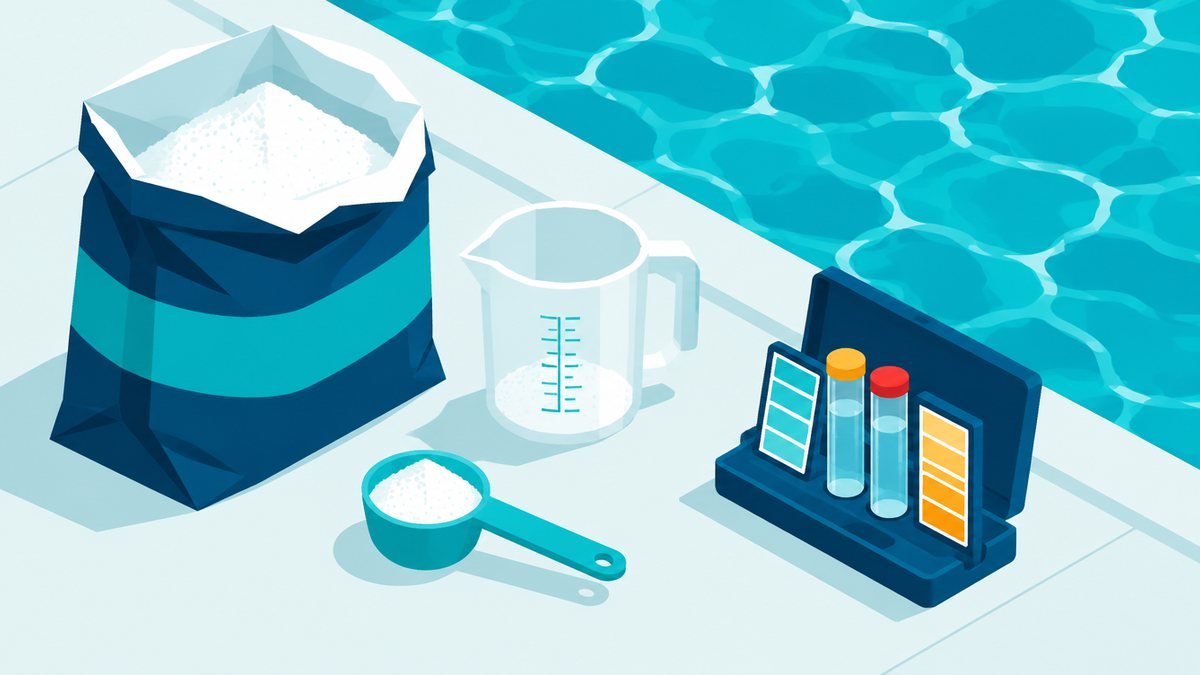
How to raise alkalinity in pool water: test total alkalinity first, then add sodium bicarbonate (baking soda or a product sold as an alkalinity increaser) in small amounts with the pump running, wait for it to circulate and retest. Taylor Technologies gives 80 to 120 ppm as the ideal range for total alkalinity, with 60 ppm as a minimum and 180 ppm as a maximum. Getting alkalinity right comes first, because it controls how stable your pH is and makes every other chemical adjustment easier.
What total alkalinity does
Total alkalinity (TA) is the buffering capacity of the water: its ability to resist changes in pH. Taylor explains that TA and pH work together. If TA is too low, pH moves around easily, which Taylor calls “pH bounce”. If TA is too high, the water is overbuffered and pH can be hard to move. The CDC recommends keeping pH between 7.0 and 7.8, and stable alkalinity is how you keep it there.
Ideal alkalinity numbers
| Reading (total alkalinity) | What it means | What to do |
|---|---|---|
| Below 60 ppm | Below Taylor’s minimum | Raise it in steps |
| 60 to 79 ppm | Low, but above the minimum | Raise slightly toward the ideal range |
| 80 to 120 ppm | Taylor’s ideal range | Leave it alone |
| 121 to 180 ppm | High, up to Taylor’s maximum | Lower it if pH keeps rising |
| Above 180 ppm | Above Taylor’s maximum | Lower it |
These ranges are for pools and spas in general. Your pool’s surface and sanitizer may call for a different target, so check your manufacturer’s guidance.
How to raise alkalinity in pool water, step by step
1. Test accurately
Use a test kit or strips that measure total alkalinity, and test before you add anything. If you use cyanuric acid, note that Taylor says it counts as alkalinity in a test when its level is high, so a reading may be higher than the true carbonate alkalinity. Our guide to pool water test kits explains how to choose one.
2. Choose the product
Sodium bicarbonate is the standard way to raise alkalinity. Taylor notes that the product that raises TA also raises pH slightly. Buy a pool-grade product, and keep it in its original container.
3. Work out a starting amount from the label
The label gives a dose for a given volume of water. Add less than the full calculated amount and retest, because it is easier to add than to remove.
4. Add it with the pump running
Wear gloves and eye protection, add the powder slowly across the water surface or as the label directs, and keep the pump running so it spreads. Don’t mix it with other chemicals.
5. Wait and retest
Let the water circulate for several hours, then test again. Repeat in small steps. Retest pH as well, since it will have risen a little.
Alkalinity first, then pH
Taylor recommends adjusting in order: total alkalinity, then pH, then calcium hardness, and retesting after each change. If both alkalinity and pH are low, raise alkalinity first and see where pH lands. Our guide to how to raise pH in pool water covers the next step.
How products affect pH and alkalinity
| Product | Effect on total alkalinity | Effect on pH |
|---|---|---|
| Sodium bicarbonate (baking soda) | Raises | Raises slightly |
| Soda ash (sodium carbonate) | Raises slightly | Raises |
| Muriatic acid or dry acid | Lowers | Lowers |
This follows Taylor’s chemistry reference. It is why a pH problem and an alkalinity problem are often the same problem.
Why alkalinity falls
- Rain and fresh fill water with low alkalinity.
- Acidic sanitizers such as trichlor, which lower pH and alkalinity.
- Over-use of acid.
- Heavy swimmer use and splash-out.
If alkalinity keeps dropping, find the cause. Our guide to how to lower alkalinity in a pool covers the opposite problem. And see cloudy pool water if the water looks hazy after you adjust it.
How to read your alkalinity test
Test strips and drop-count kits don’t all give the same precision. A strip gives a color to match against a chart, so judge it in daylight and read it at the time stated on the bottle. A titration kit counts drops until a color change, which is generally easier to read exactly. Take the sample from elbow depth, away from returns and skimmers, and rinse the vial first. If two tests disagree, repeat with a fresh sample, or take one to a pool store.
When alkalinity is low and pH is high
This combination looks odd, but it can happen when buffering is weak, so pH moves easily in either direction. Adding sodium bicarbonate to raise alkalinity helps steady it, but follow the order Taylor recommends: fix alkalinity, retest, then adjust pH if it is still out of range. Fixing the buffer first prevents you from chasing pH up and down with repeated doses.
How cyanuric acid affects your reading
If you use stabilized chlorine or add cyanuric acid, it contributes to the alkalinity reading. Taylor explains that cyanuric acid titrates as total alkalinity when its concentration is greater than 30 ppm, and gives a correction to subtract part of the cyanuric acid reading to get the carbonate alkalinity. If your numbers look strange, test cyanuric acid as well. Our guide to cyanuric acid explains the stabilizer in more detail.
The alkalinity tab of the pool chemical calculator gives the baking soda for your gallons and readings, with the 50 ppm single-dose limit built in.
Keeping alkalinity steady
- Test every week or two in season, and after heavy rain or a big party.
- Adjust in small steps and write down what you added.
- Use a sanitizer that suits your pool, since acidic products pull alkalinity down over time.
- Top up with water that you have tested, if your fill water is very low or high in alkalinity.
- Keep a simple log of readings so you can see the trend, not just one number.
A quick routine for a new pool or a fresh fill
When you fill a pool with fresh water, test total alkalinity, pH and sanitizer before anything else, because fill water can start out at almost any level. Raise or lower alkalinity first, give the water a few hours to circulate, then correct pH and sanitizer. Check the numbers again the next day. Doing it in this order, with a written note of each dose, avoids the cycle of over-correcting one number and then the other.
Frequently asked questions
What is the best way to raise alkalinity in a pool?
Sodium bicarbonate, added in small steps with the pump running and retested after circulation.
Can I use baking soda from the grocery store?
Baking soda is sodium bicarbonate, the same chemical sold as an alkalinity increaser, but pool products are packaged and labeled for the job. Follow the dose on a pool product label.
How long does it take to raise alkalinity?
It spreads as the water circulates, so retest after several hours and adjust again if needed.
Will raising alkalinity change my pH?
Yes, slightly. Sodium bicarbonate raises pH a little, so retest pH after you retest alkalinity.
Sources
Guidance changes over time, so check these pages for the latest wording.