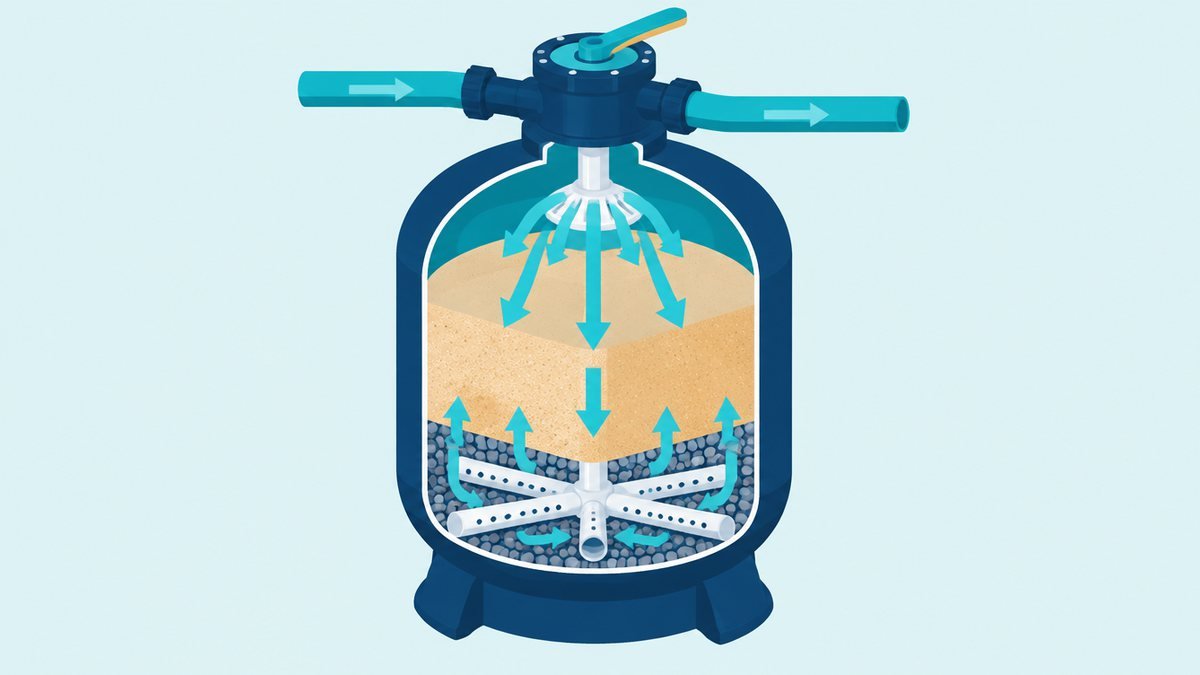
A pool sand filter cleans water by pushing it down through a bed of fine sand that traps dirt, then returning the clean water to the pool through pipes at the bottom of the tank. When the dirt builds up, the pressure gauge rises and you backwash the filter to flush it out. This guide explains how a sand filter works, how often it needs cleaning, when to change the sand and how to do it safely.
How a pool sand filter works
Water enters the top of the tank, spreads across the sand bed and passes downward. The sand traps particles, and the clean water enters small slotted pipes called laterals at the bottom and returns to the pool. A multiport valve on top of most sand filters lets you choose filter, backwash, rinse and other positions. Pentair explains that filter pressure rises and flow to the pool falls as debris collects, and that the filter removes suspended matter but doesn’t sanitize, so the water still needs the right chemistry.
When to backwash
The best signal is pressure. Pentair’s Triton guide says not to backwash on a fixed schedule such as every three days, because weather, rain, dust and pollen all change how fast the filter loads. If the system has a flow meter, backwash when the flow is 30 percent lower than after a recent backwash. If it doesn’t, backwash when the pressure gauge reads 10 PSI higher than it did just after a backwash. Backwashing too often leads to poorer filtration. Our guide to the pool filter pressure gauge explains the readings.
How to backwash a sand filter
These steps follow Pentair’s Triton manual. Always check the manual for your model.
- Stop the pump.
- Check the backwash line is open.
- Turn the valve to BACKWASH.
- Stand clear and start the pump.
- Backwash for about 3 to 5 minutes, or until the water in the sight glass or discharge runs clean.
- Stop the pump, set the valve to RINSE, start the pump and rinse for about 30 seconds.
- Stop the pump, set the valve to FILTER and open the air bleeder.
- Start the pump and close the bleeder when a steady stream of water comes out.
Always turn the pump off before moving the valve. Pentair also notes that if filter pressure after backwashing is 4 to 6 PSI above the starting pressure, the sand bed should be chemically cleaned. Our full guide on how to backwash a pool filter covers it in more detail.
When to change the sand
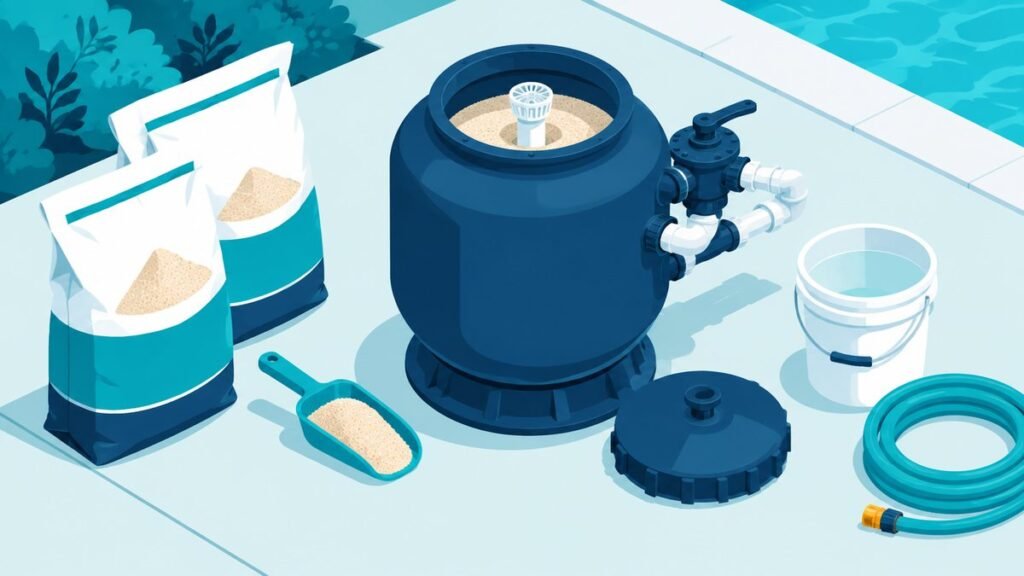
Sand doesn’t last forever. Its edges wear smooth, it can clump with oils and minerals, and a worn bed lets fine dirt through. Signs it needs replacing:
- The water stays cloudy even though chemistry is right and you backwash regularly.
- The filter cycle gets much shorter, and pressure climbs back quickly.
- Chemical cleaning no longer helps.
- You find sand in the pool, which can also point to a broken lateral.
Manufacturers’ manuals give guidance for their filters, so check yours.
How to change the sand, in outline
- Turn the pump off, switch off power at the breaker and release pressure with the air bleeder.
- Drain the tank through the drain plug and remove the valve or lid as the manual says.
- Scoop or vacuum out the old sand, covering the open laterals so nothing falls in.
- Inspect the laterals, standpipe and valve for cracks and wear, and replace damaged parts.
- Refill with the sand type and amount in the manual. For its Triton filters, Pentair specifies No. 20 standard silica sand with a particle size of 0.018 to 0.022 inch (0.44 to 0.55 mm), and lists the amount for each model.
- Rinse, reassemble, backwash and restart, then check for leaks.
Don’t use play sand or a sand grade the manual doesn’t list. The wrong grade can pass through the laterals or clog them.
Sand filter problems and quick fixes
| Problem | Likely cause | What to do |
|---|---|---|
| High pressure after backwashing | Sand clogged with oils or minerals | Chemically clean the sand |
| Low pressure and weak flow | Clogged skimmer or pump basket, air leak or closed valve | Check each in turn |
| Sand in the pool | Broken lateral or cracked standpipe, or sand that is too fine | Inspect and replace the part |
| Cloudy water | Chemistry, run time or worn sand | See cloudy pool water |
| Valve leaks | Worn gaskets or a damaged spider gasket | Replace the gaskets |
How long the pump runs also affects filtering. See our guide to the pool pump timer.
Sand, cartridge and DE filters compared
Sand filters are simple and tough, and you clean them by backwashing. Cartridge filters trap dirt in pleated fabric and are cleaned by hosing the cartridge. DE (diatomaceous earth) filters use a powder coating on grids, and they filter finer particles, but they need more care. The best filter for a pool depends on its size, the pump and how much debris it sees, so read your manual and, if you are replacing one, ask a pool professional.
A routine for a healthy sand filter
- Watch the pressure gauge and write down the clean reading after each backwash.
- Backwash when the pressure is 10 PSI above that, not on a calendar.
- Keep the pump and skimmer baskets empty.
- Chemically clean the sand when backwashing no longer lowers the pressure, as the manual describes.
- Check the valve and gaskets for leaks, and replace worn parts.
- Keep the water chemistry in range, since scale and oils shorten the life of the sand.
Winterizing the filter
Pentair’s Triton manual says to backwash, shut the pump off and open the manual air bleeder, then set a multiport valve to WINTERIZE and leave it there until the system restarts after the freeze. Drain the tank as its instructions say. Our guide on how to close a pool for winter puts this in context.
Common sand filter mistakes
- Backwashing on a calendar instead of by pressure.
- Changing the valve position while the pump is running.
- Using the wrong sand, or too little of it, when refilling.
- Ignoring a pressure gauge that has stopped working. Replace a faulty gauge so you can trust the reading.
- Skipping the rinse step after backwashing, so loose dirt returns to the pool.
- Forgetting to open the air bleeder when restarting, which leaves air in the tank.
A sand filter is one of the most forgiving pieces of pool equipment, but it still needs regular checks. Write the clean pressure on the tank or in your notes, and you’ll always know when it is time to backwash.
Frequently asked questions
How often should I backwash a sand filter?
When the pressure gauge is about 10 PSI above the clean reading, or when flow has dropped by about 30 percent, as Pentair advises, not on a fixed schedule.
How often should I change the sand in a pool filter?
When it is worn out, which shows up as cloudy water, short filter cycles and no improvement after chemical cleaning. Check your manual for guidance on your filter.
What kind of sand does a pool filter use?
The type in your manual. Pentair’s Triton manual specifies No. 20 standard silica sand. Don’t substitute other sands.
Can a sand filter be too dirty to backwash?
If backwashing no longer lowers the pressure, the sand probably needs a chemical clean or replacement.
Sources
Always check the manual for your exact model. These manufacturers are good places to confirm the details that apply to your equipment.