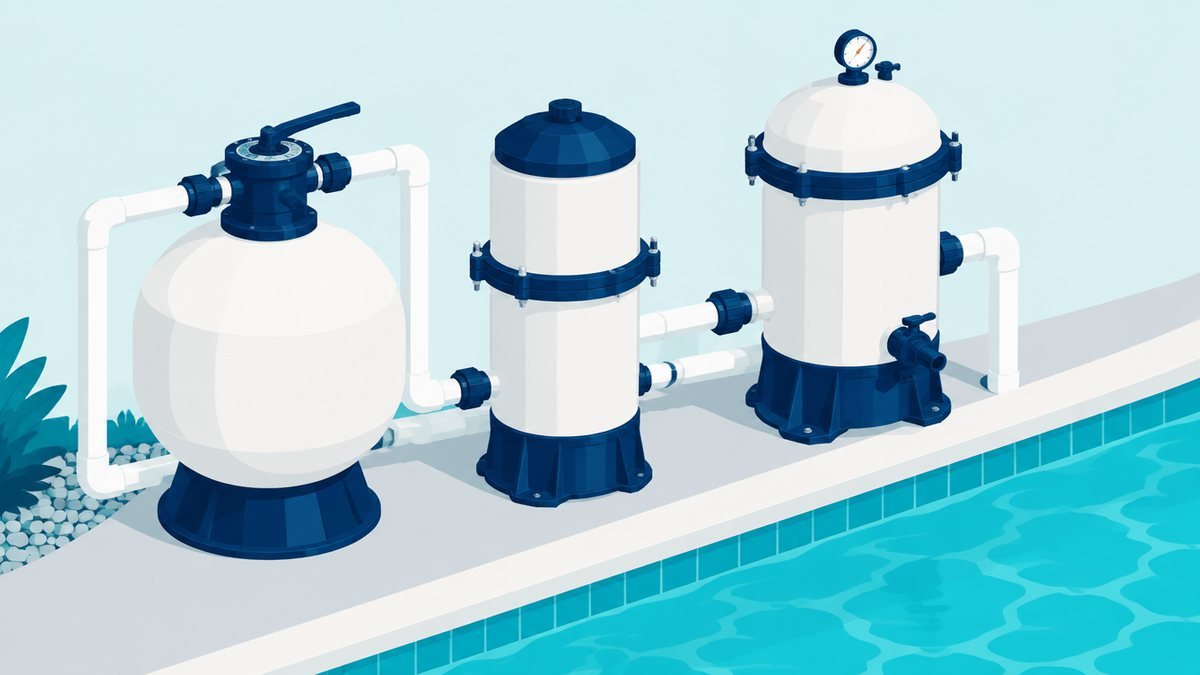
A Hayward pool filter is usually one of three types: a sand filter, a cartridge filter or a diatomaceous earth (DE) filter. Which one you have decides how you clean it, when you replace the media and which parts you’ll need. Because model names and part numbers vary, the safest way to look after a Hayward filter is to identify the model on the tank label and follow its owner’s manual. This guide explains how the three types work, how to read the pressure gauge, what the manuals say about cleaning and the parts that wear out.
The three kinds of Hayward pool filter
| Type | Filter medium | How you clean it | Key point from Hayward’s manuals |
|---|---|---|---|
| Sand | Sand bed in the tank | Backwash with the control valve | The S200 manual says to backwash when the gauge is 6 to 8 PSI above the clean pressure, and others say 8 to 10 PSI |
| Cartridge | Pleated cartridge element | Remove, rinse and clean the cartridge | Follow the manual for your model, because cartridge types differ |
| DE (diatomaceous earth) | DE powder on filter grids | Backwash, then recharge with fresh DE | The DE filter manual describes backwashing when pressure rises, then adding a fresh charge of DE |
How to identify your filter
Look for the model number and serial number on the label on the tank or the valve. Hayward sand filter manuals cover model lines such as S200, S210T and S310T2, and the DE manual covers its own series. Write the number down, then search for the owner’s manual for that model. The manual lists the maximum working pressure, the sand amount or cartridge size, the valve positions and the parts list.
Reading the pressure gauge
The gauge on top of the filter or valve is your cleaning signal. When you first start a clean filter, note the pressure. As dirt collects, pressure rises and flow falls. Hayward’s sand filter manuals say to backwash when the pressure rises a set amount above the clean reading: 6 to 8 PSI in the S200 manual, and 8 to 10 PSI in the S210T manual. The numbers differ by model, which is why you should read yours. Never operate a filter above its maximum pressure. Each manual states a limit for its model (the S200 manual, for example, says never to operate or test the system at more than 50 PSI), so check your own.
Cleaning a Hayward sand filter
- Stop the pump.
- Set the control valve to BACKWASH.
- Start the pump and backwash until the water in the sight glass is clear, or for the time in your manual.
- Stop the pump, set the valve to RINSE (if your valve has it) and rinse briefly.
- Stop the pump and return the valve to FILTER.
- Start the pump and note the new clean pressure.
Hayward’s manuals warn never to change the valve position while the pump is running. See our guides to the pool sand filter and how to backwash a pool filter for more.
Cleaning a DE filter
The Hayward DE manual explains that DE is fed through the skimmer at start-up and coats the filter elements, which then trap very fine particles. When pressure rises and flow diminishes, you backwash to flush the dirt and DE out the waste line, then re-sequence the valve to FILTER and add a fresh charge of DE. The DE amount, the schedule and how to open and rinse the grids are in your model’s manual. Dispose of used DE as your local rules require.
Cartridge filters
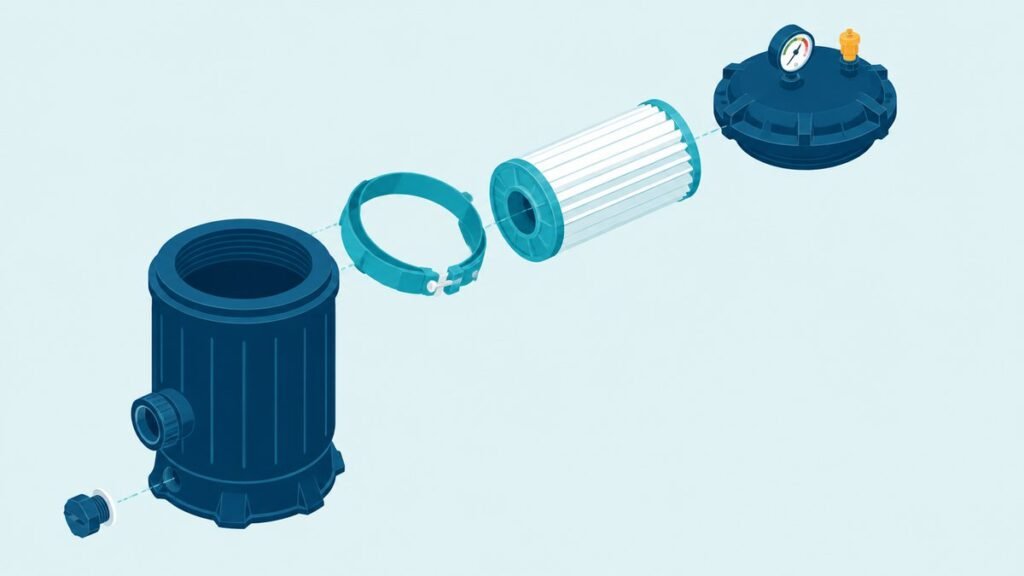
A cartridge filter has no backwash. You switch off the pump, relieve the pressure, remove the lid and cartridge and rinse it from top to bottom, then reassemble. A deep clean with a cartridge cleaner solves oils and scale. Our guide to the pool filter cartridge explains cleaning and replacing cartridges. Check your manual for the right cartridge model, and replace it when pleats are torn or flattened.
Parts that wear out
- Pressure gauge: replace if it sticks or gives odd readings.
- Valve gaskets and O-rings: they leak when worn.
- Laterals and standpipe in a sand filter: cracked parts can let sand into the pool.
- Clamp or lid O-ring: leaks around the lid are a sign.
- Cartridges or grids: replace when damaged or no longer cleaning well.
Hayward’s manuals say to use only genuine replacement parts, so ask a dealer to match your model number.
When to call a pro or replace the filter
If a tank is cracked, a clamp is damaged, the valve leaks badly or the pressure won’t drop after cleaning, a technician should inspect the filter. For help deciding between cleaning and replacing, see our guide to the DE pool filter.
Choosing between sand, cartridge and DE when replacing
Sand filters are simple to operate and need little hands-on cleaning, and cartridge filters avoid backwash water but need hand cleaning. DE filters capture the finest particles but need more care and fresh DE after each backwash. The right choice depends on your pool size, your pump, how much debris the pool sees and local rules about discharging backwash water. Ask a pool professional to check that the filter’s rated flow suits your pump, because a filter that is too small for the pump will clog quickly. Our guide to the pool sand filter and the DE pool filter compare the details.
Keeping records for your filter
Write the model number, the date you installed or last replaced the media and the clean pressure on a card kept near the equipment. Photograph the label and the parts list from the manual. When something wears out, you can order the right part quickly, and when a technician visits, you can give accurate information. Add the date of each chemical clean so you can tell if the filter is clogging faster than usual.
Questions to ask a dealer about a Hayward filter
- Which filter model is on my pool, and what is its maximum pressure?
- What flow does it need, and does my pump match?
- Which parts commonly wear out, and are they in stock?
- Does the model need a specific sand, cartridge or DE amount?
- What does the warranty cover, and how do I register it?
Frequently asked questions
How do I know when to backwash my Hayward filter?
When the pressure gauge is above the clean pressure by the amount in your manual. For example, 6 to 8 PSI in the S200 manual, or 8 to 10 PSI in the S210T manual.
What type of sand does a Hayward sand filter use?
The manual lists the type. The S200 manual specifies 0.45 to 0.55 mm sand, also known as No. 20 silica sand.
Can I use any replacement part?
Hayward says to use only genuine Hayward replacement parts, and your model number helps a dealer match them.
Why is my filter pressure high after backwashing?
The sand or DE may be clogged with oils or scale, or there may be a flow restriction. See your manual and consider chemical cleaning.
Sources
Manufacturers update their instructions from time to time, so confirm anything model-specific in your current manual. Sources used here: