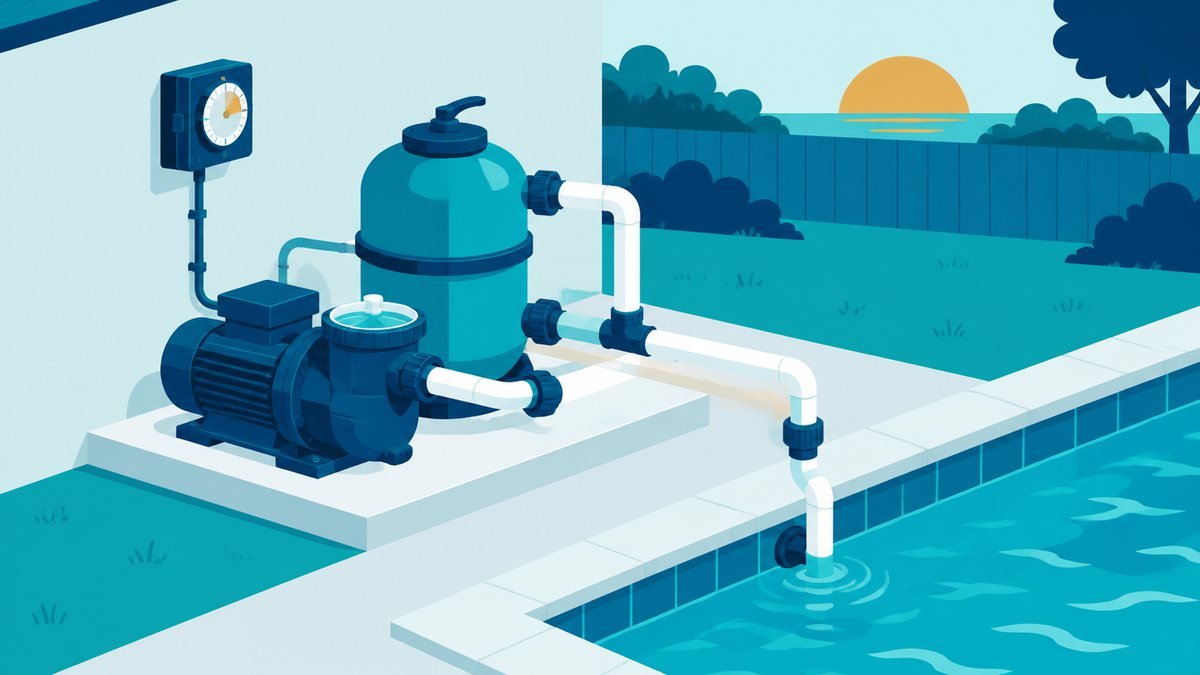
How long to run a pool pump depends on your pool and your pump, but the principle is simple: run it long enough to filter all the water at least once a day, and no longer. A pool pump timer lets you do that automatically, and cutting unnecessary run time is one of the easiest ways to lower your pool’s electricity use. This guide explains how to work out run time for your pool, how timers work and what to change in summer and winter.
What a pool pump timer does
A pool pump timer switches the pump on and off at set times. A mechanical timer is a dial with pins or trippers you set by hand, a digital timer lets you program several on and off periods, and an automation system or a variable-speed pump’s built-in schedule does the same job with more control. It saves you remembering, and it lets you move pumping to times that suit you.
How long should you run a pool pump?
The goal is turnover: pumping the full volume of the pool through the filter. To work it out, divide your pool volume by the flow rate your pump delivers through your filter, and you get the time for one turnover. The U.S. Department of Energy’s pool pump guide notes that the Association of Pool and Spa Professionals suggests a pump be capable of turning over the entire pool volume twice in 24 hours, but that the actual turnover can be slower when conditions permit. Heavy use, debris or hot weather call for more, and the right number depends on bather load, weather and filter performance. If the water is clear, the filter pressure is normal and the chemistry stays in range, your run time is working.
ENERGY STAR gives a useful example: running a pool filter for only 6 hours a day instead of 24 would cut energy use by 75 percent. Check your manual or ask a pool professional for the flow your equipment delivers, and treat the clarity of your water as the final test.
Single-speed vs variable-speed pumps
A single-speed pump runs at one fixed speed, so run time is your main lever. A variable-speed pump can run slowly for long hours, and ENERGY STAR explains why that saves energy: reducing pump speed by half allows the pump to use just one-eighth as much energy, because filtering needs about half the flow of running a pool cleaner. DOE’s guide sums up the idea as “run it slower and run it longer.” For a pump you can set to different speeds, a schedule with a long, slow filtration period and a short faster period for the cleaner usually works well. Our guide to variable speed pool pumps covers the details.

When to run the pump
- During the day. Most swimming and debris happen in daylight, so circulation then keeps sanitizer mixed and carries debris to the filter.
- Off-peak hours. If your utility charges by time of day, run the pump when electricity is cheaper.
- In several shorter cycles. ENERGY STAR notes that a timer that runs the pump for several short periods can keep a pool with a debris problem cleaner than a single long run.
- Around chemical additions. After adding chemicals, keep the pump running so they mix.
- With cleaners and heaters. A robotic or suction cleaner and a heater need the pump on, so schedule them inside the run window.
Adjusting for the season
In hot weather and heavy use, water needs more filtration and sanitizer, so you may need longer run times. In cold weather, algae grow slowly and run times can drop, but don’t just switch the pump off if freezing is possible, because moving water is less likely to freeze. If a freeze is expected, follow your equipment manual. When you close the pool for the season, see how to close a pool for winter.
How to set up a mechanical timer
- Switch off the power at the breaker before opening the timer box.
- Set the dial to the current time by turning it in the direction the arrow shows.
- Move the on and off trippers to the times you want, and check which side of the dial is on and which is off.
- Close the box, restore power and watch the pump start and stop at the set times for a day.
- Check after a power cut, because the dial can be wrong afterwards.
Signs your run time is wrong
- Too short: cloudy or green water, high chemical use, dirty tiles and a filter that keeps clogging.
- Too long: a high electric bill with water that was already clear.
Test the water, check the filter pressure and adjust by small amounts. Our guide to cloudy pool water explains what to do when the water won’t clear.
Which timer type should you use?
| Timer type | How it works | Good to know |
|---|---|---|
| Mechanical dial | Pins or trippers set by hand on a dial | Simple and cheap, but loses time after a power cut |
| Digital | Programmable on and off periods | Allows several programs a day, and some keep time with a battery |
| Automation system | Schedules pumps, heaters, lights and cleaners together | Some can protect against freezing automatically |
| Variable-speed schedule | Built into the pump, with different speeds at different times | No separate timer needed |
How to check that your run time is right
Look at four things after a week of a new schedule. The water should be clear, the walls and floor should stay clean, the filter pressure shouldn’t climb faster than before and your chemical use should be stable. If everything is in good shape, try shortening the schedule a little at a time until you find the point where problems start to appear, and then go back up slightly. That is the cheapest run time for your pool. Remember that ENERGY STAR’s figure of a 75 percent saving is for cutting from 24 hours to 6; your own saving depends on what you run now.
Common timer mistakes
- Setting the on and off times but leaving the manual override on, so the timer never controls the pump.
- Running the pump only at night, when the pool is least used and sanitizer isn’t being consumed.
- Forgetting to reset a dial timer after a power cut, so the pump runs at the wrong hours.
- Cutting the run time after a few clear days and then seeing the water turn cloudy during a hot spell.
- Scheduling a heater or cleaner outside the pump’s run window.
- Ignoring the filter pressure gauge, which shows whether the filter is keeping up.
If you notice the pump struggling, noisy or losing prime, the timer isn’t the problem. Switch it off and have the pump checked rather than relying on a schedule to hide an equipment fault.
Frequently asked questions
How many hours a day should I run my pool pump?
Enough to filter all the water at least once. Many pools need one to a few full turnovers a day, depending on use and weather. Adjust until the water stays clear.
Is it better to run a pool pump at night?
Day running helps circulate sanitizer, and night running can be cheaper if your electricity rates vary. Many owners run during the day, or use an off-peak schedule.
Can I turn the pool pump off in winter?
In freezing weather, don’t just switch it off without protecting the plumbing. Follow your manual, or close the pool properly for winter.
Do I need a timer if I have a variable-speed pump?
Variable-speed pumps usually have a built-in schedule, so a separate timer isn’t needed.
Sources
These public agencies publish guidance that is a good place to confirm the details on this topic.