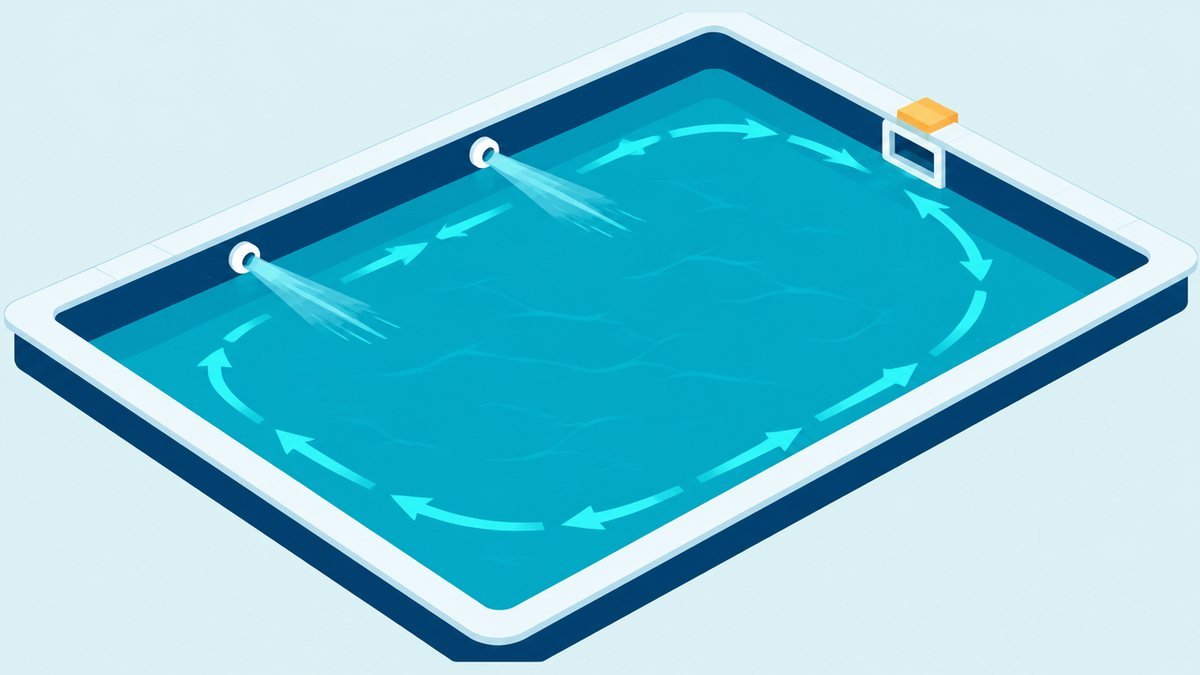
Pool return jets should be aimed so the water forms a slow, steady circle that carries debris toward the skimmer and mixes chemicals through the whole pool. Most owners get the best result by angling the returns slightly downward, turned in the same direction so they push the surface water around the pool rather than straight across it. Aiming matters because even a good pump and filter can leave dead spots if water doesn’t reach every corner. This guide explains what return jets do, how to aim them for different problems and what to do when circulation still seems poor.
What pool return jets do
Return jets, also called return fittings or eyeballs, are the openings in the pool wall where filtered water goes back into the pool. They determine how the water moves. The skimmer and main drain pull water out, the returns push it back in, and the pattern between them decides where leaves collect, where chemicals mix and where heat spreads. The U.S. Department of Energy’s pool pump guide stresses that a properly functioning circulation system matters, because a poorly filtered pool can incubate pathogens and algae.
How circulation works in a typical pool
In a typical pool, the skimmer sits on one side and the returns on another. Water leaves through the skimmer and main drain, goes through the pump, filter and any heater, and comes back through the returns. Aim the returns well and the water moves in a gentle loop. Aim them badly and you get a stagnant corner, a swirl that fights the skimmer or turbulence that churns leaves around instead of delivering them to the basket.
How to aim your pool return jets
| Problem you see | What to try |
|---|---|
| Leaves collect on the surface far from the skimmer | Point the returns across the surface toward the skimmer side, angled slightly down |
| Floor looks dirty or algae start on the bottom | Angle the returns lower so they stir the floor, and brush the dead spots |
| Dead corners with green streaks | Aim a return so that it points into the corner, and brush the area |
| Air bubbles keep coming from the returns | Check the water level and the pump basket for air leaks before you change the aim |
| Water barely moves anywhere | Check the pump and filter before you adjust the jets |
Pentair’s skimmer manual gives similar advice in its troubleshooting table. For inadequate circulation it says to position the pool water return fittings to increase surface circulation, and where the bottom is dirty it says to position them to increase circulation at the bottom.
Step by step: setting the aim
1. Start with the water level and the baskets
A low water level or a full basket changes the flow, so correct these first. Pentair’s manual lists a low pool water level as a cause of poor skimming and air in the water.
2. Turn the returns in the same direction
Looking at the pool from above, aim each return so that it points slightly to the right or left of straight, and the same way around the pool. The water then travels in a circle.
3. Angle them slightly down
A small downward tilt helps stir the lower water without breaking the surface. Too steep and you get a spray of bubbles, too shallow and the bottom is neglected.
4. Watch what happens
Drop a little fine debris or watch a leaf. Does it drift toward the skimmer? Adjust a little at a time and check again after a few minutes.

5. Re-aim when conditions change
Wind, a new cleaner or a change in the pump’s speed can change the pattern. Many return fittings swivel so you can adjust the direction, and some come with interchangeable nozzles that change the flow. Check what yours allows, and try a different nozzle on a stubborn pool.
Wind, skimmers and returns together
Pentair’s Bermuda guide says a skimmer should be placed with the prevailing wind and the direction of water flow in mind, and that a balance plate shifts flow between the skimmer and the main drains. Wind is free help. If the breeze blows to the skimmer side, aim the returns to add to it. If it blows the other way, a stronger return flow toward the skimmer helps. Balancing the skimmer and drain flow is part of the same job.
Returns and heaters
Water returning from a heater is warmer than the pool, and where it enters affects how the heat spreads. Aiming a return downward helps mix heated water through the pool instead of letting it float on top. If the pool heats unevenly, check the aim before assuming the heater is weak, and see pool heater repair for heater-side checks.
If aiming doesn’t fix circulation
Aim fixes the pattern but not a lack of flow. If water still barely moves, check the filter pressure, the pump strainer and the schedule. A pump that runs too few hours leaves the water stagnant whatever the aim. Our guide to the pool pump timer explains how long to run it. If the water is hazy or green in places, read about cloudy pool water. And if you vacuum by hand, see how to vacuum a pool.
Different pool shapes and returns
Rectangular pools with returns on one short wall do well with a single sweeping circle. Pools with a deep end, steps or a tanning ledge create pockets that need an extra return aimed into them. Freeform shapes often have more than one skimmer, so you may need to give each return its own task. Walk around the pool after an adjustment and check the corners, the steps and the area behind the ladder, because those are the places that go green first.
Returns, cleaners and chemicals
If you use a robotic or suction cleaner, check that the returns don’t push it into a corner or trap it against the wall. When you add chemicals, aim the nearest return across the area to spread them quickly. If you add a product such as granular chemical, keep the pump running so it mixes, and use the returns to carry it around. Good circulation is one of the cheapest ways to improve water quality, because it makes the sanitizer you already have work better.
Frequently asked questions
Which way should pool return jets point?
Slightly down and in the same direction around the pool, so the water forms a gentle circle that moves debris toward the skimmer.
Why are there bubbles coming from my pool returns?
Common causes are a low water level, an air leak on the suction side or a full pump basket. Check those before changing the aim.
Should return jets point up or down?
Mostly across the surface with a slight downward angle. Pointing them straight up creates spray, and straight down stirs only the floor.
Can I change the return nozzle size?
Some fittings come with several nozzle sizes, where a smaller nozzle usually gives a stronger jet and a larger one a gentler flow. Check what your fitting allows.
Sources
Check the owner’s or installation manual for your specific unit, since brands and models vary. These pages back up the details above.