
A wood-fired hot tub is heated by a stove that burns wood, either built into the tub or connected to it by pipes, so it runs without electricity. That makes it popular in places without power, but it also makes it a solid-fuel appliance, with real fire, burn and carbon monoxide risks that an electric hot tub doesn’t have. This guide explains how wood-fired hot tubs work, how they compare with electric tubs, how to use one safely and what to check before you buy or install.
How a wood-fired hot tub works
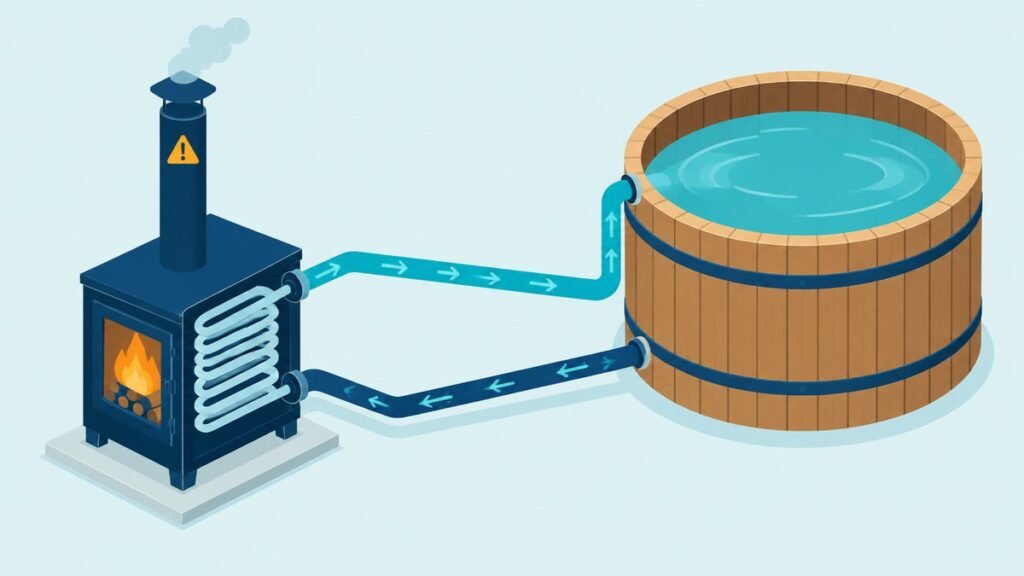
There are two common designs. In an internal-stove tub, a small wood stove sits inside the tub and is separated from the water by a guard, and it heats the water directly. In an external-stove tub, a stove stands outside, usually on a non-combustible base, and water circulates by natural convection between the stove and the tub through two pipes. Hot water rises through one pipe and cooler water returns through the other, so no pump is needed in the simplest designs. The stove burns firewood, and a chimney carries smoke away.
Wood-fired vs electric hot tubs
| Wood-fired | Electric | |
|---|---|---|
| Energy source | Firewood | Electricity |
| Power needed | None for simple designs | Outlet or hardwired circuit |
| Heating | Depends on the fire, slow to start | Controlled by a thermostat |
| Temperature control | Manual, by fire and water mixing | Automatic |
| Main hazards | Fire, burns, carbon monoxide, hot surfaces | Electric shock, scalding |
| Setup | Chimney, firewood storage and clearances | Electrical supply |
The main risks
- Fire. Hot stove surfaces, sparks and chimney heat can ignite nearby materials. Mass.gov’s fire safety guidance for solid-fuel stoves says to keep the area around the appliance clear for at least three feet in every direction.
- Carbon monoxide. Smoke and fumes build up if the chimney is blocked or poorly drawn. The Consumer Product Safety Commission warns that carbon monoxide is odorless and can kill.
- Chimney fires. Mass.gov notes that most chimney fires occur because of a build-up of creosote, a tarry byproduct of burning wood, and recommends burning only dry, seasoned hardwood.
- Burns and scalding. Stove parts and the water itself can be dangerously hot.
- Overheating. Without a thermostat, the water can get hotter than is safe if the fire is too strong.
Safe siting and installation
Follow the manufacturer’s installation manual, whose clearances override any general rule. As a rough guide from fire safety agencies for solid-fuel appliances:
- Place the stove on a non-combustible base, away from fences, decks, trees and overhanging branches.
- Keep at least the manufacturer’s clearance to anything that can burn. Mass.gov advises at least three feet for solid-fuel stoves.
- Use a chimney of the right size and height, and keep it clear of branches.
- Check local rules, because solid-fuel appliances may need a permit or inspection. Mass.gov notes that a building permit and inspection are required for solid-fuel stoves there.
- Tell your insurer, because an undisclosed solid-fuel appliance can affect a claim.
How to use a wood-fired hot tub safely
Fuel
Burn only dry, seasoned hardwood, as fire safety guidance advises. Never burn treated, painted or wet wood or rubbish, and never use gasoline or other flammable liquids to start the fire.
Lighting and managing the fire
Light the fire with kindling and let it build. Keep a steady, moderate fire instead of a roaring one. Watch the water temperature often with a thermometer, and stop adding wood when the water is warm enough.
Never leave the fire unattended
Stay nearby while it burns, keep children and pets well away from the stove and don’t use the tub if the fire is dying down to smoke.
Ash and cooling down
Let the stove cool fully. Remove ash into a metal container with a lid and keep it away from anything that can burn, because ash can hold hot embers for a long time.
Water care and upkeep
Wood-fired tubs still need clean water. Many are drained and refilled regularly, and some use filters and sanitizers. The CDC recommends keeping hot tub water at pH 7.0 to 7.8 and at least 3 ppm of chlorine when a chlorine sanitizer is used, and it advises testing often. Clean the stove and flue as the manufacturer directs, and have a chimney inspected and cleaned each year, as Mass.gov advises. Our guide to hot tub maintenance covers the routine.
Winter use and shutdown
If you leave the tub in freezing weather, drain it, remove water from pipes and the stove coil and cover it, because ice can crack them. See how to winterize a hot tub, and check your tub’s manual for model-specific steps.
Is a wood-fired hot tub right for you?
It suits people who like the ritual of a fire, want off-grid heating and are happy to tend it. It isn’t a good fit if you want instant, controlled heat, if you can’t keep a safe clearance or if children are often around. If you want a comparison of what an electric tub costs to buy and run, read how much a hot tub costs.
Questions to ask the seller or installer
- What are the stove’s required clearances, and what does the manual say about the chimney height?
- Does the stove carry a recognized safety listing, and can I see the paperwork?
- How is the water temperature controlled, and is there a safety guard on the heater?
- What parts of the tub are wood, and how do I treat and maintain them?
- Do I need a permit or an inspection where I live?
- What does the warranty cover, and does it cover fire or smoke damage?
Common mistakes
- Installing the stove too close to a fence, wall or tree.
- Using green or wet wood, which smokes and builds creosote.
- Letting the water get too hot because the fire runs unattended.
- Skipping carbon monoxide alarms because the tub is outdoors.
- Ignoring local rules about solid-fuel appliances.
- Leaving ash in a cardboard box or against the fence.
Frequently asked questions
How long does a wood-fired hot tub take to heat?
It depends on the tub, the stove, the starting water temperature and the weather, and manufacturers give different times. Expect it to take longer than an electric tub.
Are wood-fired hot tubs safe?
They can be if the stove and chimney are installed to the maker’s instructions, clearances are respected, you use dry hardwood and carbon monoxide alarms are in place. They carry more fire and burn risk than electric tubs.
Do wood-fired hot tubs need electricity?
Simple designs don’t. Some add a pump, filter or lights, which do need power.
Can I use any wood stove for a hot tub?
No. Use a stove designed for the tub, installed to its manual, and check local rules.
Sources
These public agencies publish guidance that is a good place to confirm the details on this topic.