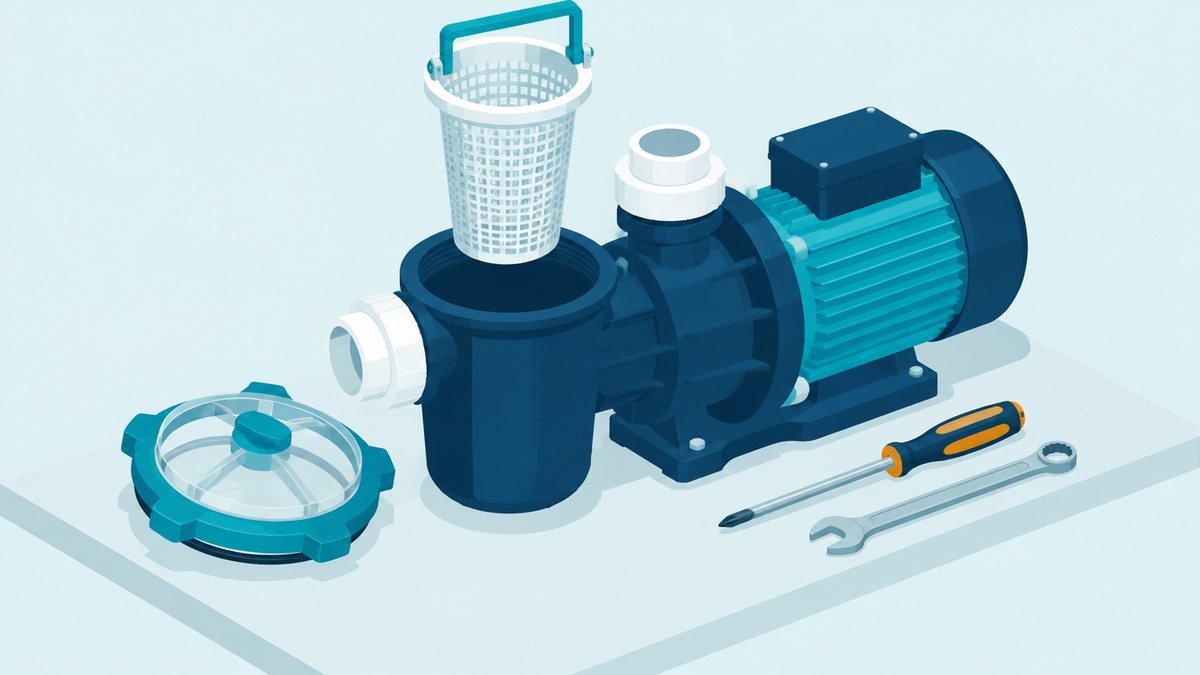
Pool pump repair usually starts with a symptom rather than a part: the pump will not prime, hums without starting, shuts off, leaks, makes noise or moves too little water. Each symptom has a short list of likely causes, and the manufacturer’s troubleshooting guide is the best map. Some fixes are safe for a careful owner, such as cleaning a basket or replacing a lid O-ring, while others involve live wiring, motor internals or seals and belong with a technician. This guide walks through the common faults, what the Hayward manual says about each and where to stop and call for help.
Before you start any pool pump repair
Hayward’s manual also says never to run a pump dry, because water cools and lubricates the shaft seal, and to fill the strainer housing before starting. It tells owners to stand well back from the pump and filter when starting a system that has been opened.

Quick troubleshooting table
| Symptom | Common causes | What to check |
|---|---|---|
| Motor will not start | Tripped breaker, loose wiring, blown fuse, bad timer, seized shaft | Breaker, GFCI, timer, and whether the shaft turns freely with the power off |
| Motor hums but does not start | Debris jamming the impeller | Have a professional open the pump and clear the impeller |
| Motor shuts off | Low voltage, undersized wiring, overheating | Wire size and supply voltage, ventilation, thermal overload |
| Pump will not prime | Empty strainer housing, air leak on the suction side, dirty baskets, clogged suction | Water in the housing, lid O-ring, unions and valves |
| Low flow | Clogged basket or filter, partly closed valve, air leak, damaged impeller | Baskets, filter pressure, valve positions |
| Noisy pump | Air in the suction line, low water level, worn bearings, debris | Water level, suction connections, bearings |
| Leaking at the pump | Worn shaft seal, bad O-ring or gasket, cracked housing | Where the water appears and when |
The pump will not prime
This is the most common complaint. Hayward’s manual says a self-priming pump will not prime if there are suction air leaks, which show up as bubbles coming from the return fittings on the pool wall. Its checklist runs in this order:
- Make sure the pump strainer housing is full of water, and that the cover O-ring is clean, seated in its groove and lubricated.
- Tighten loose connections on the suction side.
- Check for leaking O-rings or packing glands on valves.
- Empty the strainer and skimmer baskets and refill the housing.
- If the suction line seems clogged, call a qualified repair professional.
Hayward adds that priming can take up to ten minutes depending on how high the pump has to lift the water, and that if it does not prime within five minutes you should stop the motor and find the cause. Our dedicated article on pool pump not priming goes into more detail.
Motor hums but does not start
Hayward lists a jammed impeller as the first thing to check, and its solution is to have a qualified repair professional open the pump and remove the debris. A hum with no rotation can also point to a failed start capacitor, which is covered in our guide to the pool pump capacitor. Jacuzzi’s repair basics make the same link for spa pumps, saying that a loud humming noise without water flow often points to a faulty capacitor. A capacitor stores a charge, so leave testing and replacement to someone who knows how to discharge it safely.
Motor shuts off or trips
Hayward’s guide says low voltage at the motor, often caused by undersized wiring or an extension cord, can shut the motor off. The motor also has an automatic thermal overload protector that shuts it off to prevent damage and allows it to restart after it cools, and it keeps cycling on and off until the cause of overheating is fixed. Check ventilation around the motor, remove anything that blocks airflow and have a qualified person check the wire gauge and the voltage. The manual says the voltage at the pump must not be more than 10 percent above or below the nameplate rating.
Low flow and weak pressure
Hayward’s low-flow list starts with a clogged or restricted strainer or suction line, then undersized piping, a plugged or restricted filter or a partly closed valve, an air leak in the suction and a damaged impeller. For the filter, its advice is to backwash sand and D.E. filters as the manufacturer directs and to clean or replace a cartridge. Check the filter pressure gauge first, since a dirty filter is the cheapest cause to fix. See pool filter cartridge for cartridge care.
Noisy pump
Hayward’s noise checklist covers an air leak or cavitation from a restricted or undersized suction line, a low water level, vibration from poor mounting, debris striking the impeller and worn motor bearings. The manual says chemical-damaged seals can let chlorinated water into the bearings, causing a whine, and that seal leaks should be replaced right away. Mounting the pump on a level pad and fixing the suction side often quiets it.
Leaks and seal replacement
Water dripping from between the motor and the wet end usually comes from the shaft seal. Hayward notes that seals occasionally have to be replaced because of wear or damage, and that only qualified personnel should attempt rotary seal replacement, since the graphite and ceramic faces scratch easily. If you do replace a seal, use the exact kit for your pump and follow the manual’s steps.
When to repair and when to replace
A repair makes sense for a lid O-ring, basket, seal or capacitor. If the motor has failed, the housing is cracked or the pump is old and inefficient, compare the repair estimate with the cost and savings of a new variable-speed model. See the variable speed pool pump guide for what a newer pump offers.
Frequently asked questions
Why is my pool pump humming but not running?
The impeller may be jammed, or the capacitor may have failed. Turn off the power and have a professional inspect it.
Why does my pool pump keep shutting off?
Low voltage, overheating or a tripped overload protector are common reasons. Check ventilation and the supply, and call an electrician if it continues.
Can I replace the shaft seal myself?
Some owners do, but Hayward advises that only qualified personnel should attempt it, and the parts must match your pump model.
How do I stop my pump from losing prime?
Keep the strainer lid O-ring clean and lubricated, keep baskets empty and check unions and valves for air leaks.
Sources
For your exact model, the manufacturer’s documentation is the authority. These sources are good places to start.