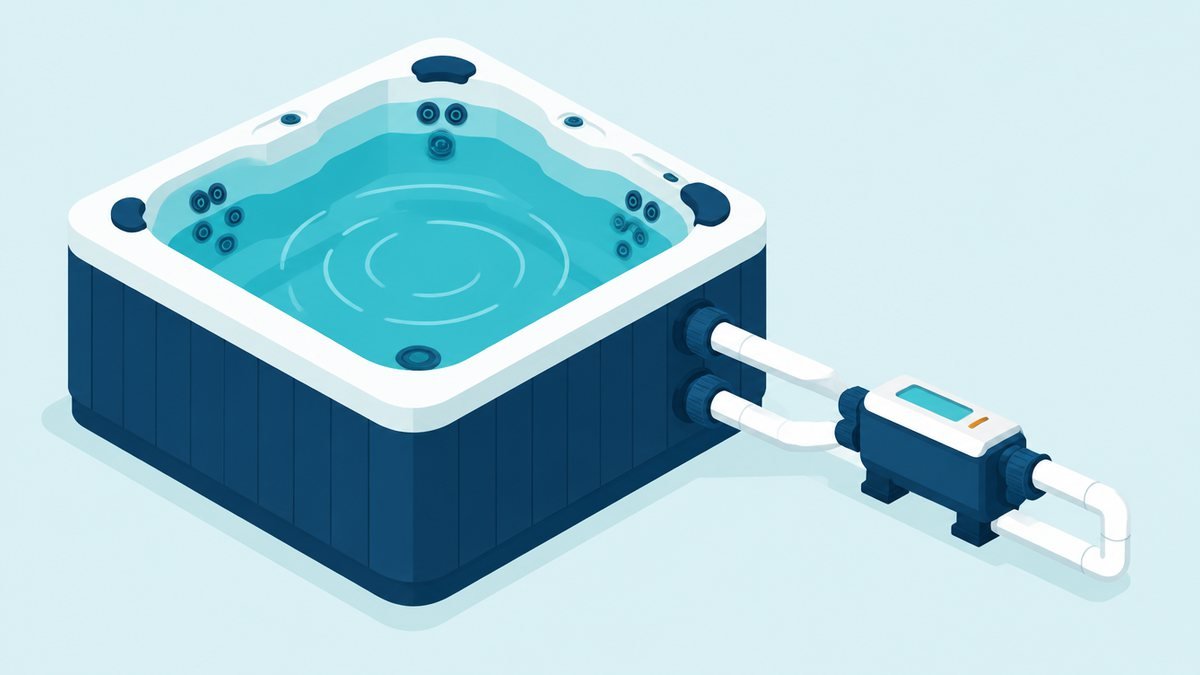
A salt water hot tub does not run on ocean water or on salt alone. It uses a salt system, a small cell that turns dissolved salt into chlorine by electrolysis, so the tub makes its own sanitizer instead of relying on chlorine you add by hand. The water feels softer to many people and needs fewer daily additions, but the tub still needs testing, balancing, cleaning and draining like any other. This guide explains how a salt water hot tub works, what it saves you, what it does not and what upkeep to expect.
How a salt water hot tub works
You add spa salt to the water, and the water flows past a cell with electrodes. An electric current splits the salt, and the result is chlorine, which sanitizes the water and then reverts partly back to salt. Hot Spring describes its FreshWater Salt System as a titanium cartridge that creates chlorine from salt, with the chlorine output set on the control panel. The company says the system keeps the water clean, clear and sanitized for up to a full year under proper maintenance, and that factors such as bather load and water chemistry affect how long water lasts.
So a salt water hot tub is still a chlorine hot tub. The difference is where the chlorine comes from: it is generated in the tub at a low, steady rate instead of being added as granules or tablets.

Salt water versus a traditional chlorine or bromine tub
| Point | Salt water hot tub | Traditional chlorine or bromine tub |
|---|---|---|
| Source of sanitizer | Made from salt by a cell | Added by hand as granules, tablets or liquid |
| Daily effort | Lower. Set the output, then test and adjust | Higher. You dose it as it is used up |
| Water feel | Often described as softer | Can feel harsher if chloramines build up |
| Parts that wear | The salt cell or cartridge, which is replaced | None, but chemicals are an ongoing purchase |
| Up-front cost | Higher, because of the salt system | Lower |
| Still needs | Testing, pH and alkalinity balance, cleaning and draining | The same |
What a salt system does not do
- It does not remove the need to test. Hot Spring’s guidance is to test and balance with a 5-way strip that measures chlorine, pH, alkalinity and calcium hardness, and to keep chlorine at a minimum of 3 ppm. That matches the CDC, which recommends at least 3 ppm of chlorine and a pH of 7.0 to 7.8 in hot tubs.
- It does not clean the filter or the shell. You still rinse the filter and wipe the shell.
- It cannot fix a poor fill water supply. Hot Spring suggests testing the fill water and checking for high levels of metals, phosphates and calcium before you start.
- It does not mean you can skip shocking forever. Heavy use, rain and dull water may still call for an oxidizer. See hot tub shock.
Setting up and maintaining a salt system
Salt levels, startup steps and cell life vary by brand, so use your manual rather than a general figure. As an example of one manufacturer’s approach, Hot Spring’s startup steps call for turning the salt system off, running the jets, adding salt to reach a target of 1750 ppm, and adding chlorine to reach 5 ppm before the tub is ready to use. Other brands use different numbers.
- Add salt with the jets running, and add it gradually, testing as you go.
- Use the salt type the manual names. Manufacturers name the salt they want, so check the manual before you substitute a different product.
- Check the system status. Hot Spring’s control panel prompts a check every ten days and refreshes the system status every thirty minutes.
- Replace the cell on schedule. Hot Spring says to replace its cartridge about every four months, and other brands may use a longer-lived cell that you clean instead.
- Watch the water balance. Test pH and alkalinity regularly, since they can drift as the cell runs. See hot tub water tester kit.
Does salt damage a hot tub?
Salt water at the low level used in hot tubs is much less salty than the sea, but salt can still affect certain materials. Manufacturers design their tubs and equipment for specific systems, so check the warranty and the manual before you add a salt system to a tub that did not come with one. Rinse any splashed salty water from the cover and the surrounding deck, and keep the cover clean and dry. Our guide to hot tub covers explains cover care.
Is a salt water hot tub worth it?
It suits owners who value steadier water, fewer daily additions and are willing to pay more up front for the system and its replacement parts. It is less attractive if you use the tub only rarely, you prefer to handle chemicals directly or your tub’s manufacturer does not support a salt system. Always compare the total ownership cost: the system, the cells and the salt, against the chemicals you would otherwise buy.
Questions to ask before you buy or convert
- Is the salt system made or approved by my tub’s manufacturer, and does it affect the warranty?
- What is the cell or cartridge rated for, and what does a replacement cost over a few years?
- Which salt, test strips and balancing products does the manual call for?
- How does the control panel show the salt level, the cell status and any fault?
- Who services the system near me if something fails?
Comparing these answers is more useful than comparing marketing claims, and it tells you the real cost of ownership.
Frequently asked questions
Is a salt water hot tub chlorine-free?
No. The cell makes chlorine from the salt, so the tub is still sanitized by chlorine, just produced in the tub instead of added by hand.
Can I convert my existing hot tub to salt water?
Some tubs can use an add-on system, but check with the manufacturer first, because the warranty, the plumbing and the cell size all matter.
How often do I drain a salt water hot tub?
It depends on the use and the brand. Hot Spring says water can last up to a year when the system is properly maintained, while Jacuzzi’s maintenance tips suggest draining about every three months for its tubs. Follow your manual and your test results.
Do I still need to test the water?
Yes. Testing is how you know the system is keeping up, and the CDC recommends routine testing of chlorine and pH.
Sources
Check the owner’s or installation manual for your specific unit, since brands and models vary. These pages back up the details above.