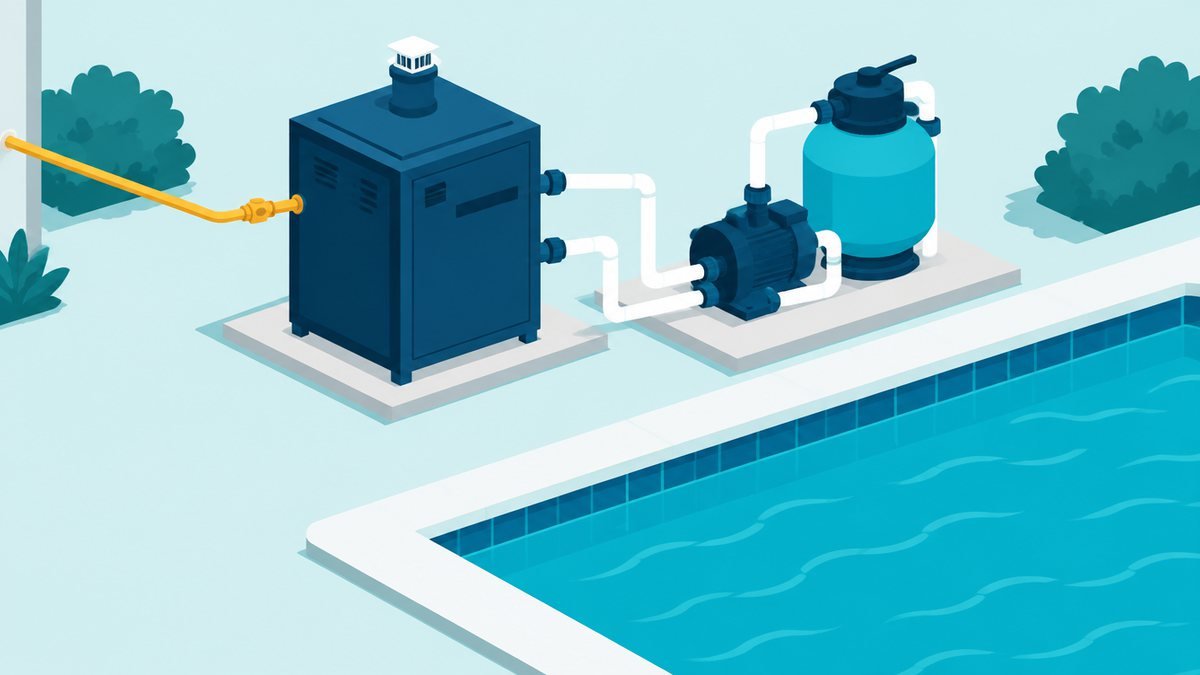
A gas pool heater burns natural gas or propane to heat pool water as it flows through the unit, and it does so on demand, which is why it can raise the temperature of a pool or spa faster than most other heater types. Water from your pump and filter passes through a heat exchanger, a burner heats the exchanger and the warmed water returns to the pool. A gas pool heater works in cold weather, which is its main advantage, but it needs a gas supply, correct venting and a steady flow of water to run safely. This guide explains how a gas pool heater works, what the parts do, what the manufacturers say about flow and chemistry and how to use one safely.
How a gas pool heater works
The cycle starts when the heater’s control sees that the water is cooler than your setpoint. Hayward’s troubleshooting guide for its Universal H Series heaters lists the sequence that follows. The control compares the set temperature with the actual water temperature, and when the water is a degree below the setpoint it starts a sequence:
- The control checks that the blower’s vacuum switch is open.
- The blower starts a pre-purge cycle, clearing the combustion chamber, while the ignitor heats up for about twenty seconds.
- The control checks that the vacuum switch has closed, which proves the blower is moving air.
- At the right ignitor temperature, the gas valve opens for a trial of about four seconds, and a flame sensor confirms that the burner has lit.
- While the flame is on, the control keeps monitoring the blower switch, the temperature sensor and the flame sensor.
- When the water reaches the setpoint, the gas valve closes, the flame goes out and the blower runs for about thirty seconds more to clear the chamber.
If the burner fails to light, the heater tries again. Hayward says that after three failed trials the heater locks out and shows an ignition failure code, waits sixty minutes and then tries three more times, and it keeps repeating this while the thermostat calls for heat.

The main parts of a gas pool heater
| Part | What it does |
|---|---|
| Heat exchanger | Carries pool water past the flame so heat transfers into the water |
| Burner and gas valve | Mix and burn the fuel, controlled by the valve |
| Blower or draft system | Moves combustion air in and exhaust out |
| Ignitor and flame sensor | Light the burner and prove that it is lit |
| Water pressure switch | Confirms water is flowing before the burner can fire |
| Temperature sensor and high-limit switch | Read the water temperature and shut the heater down if it gets too hot |
| Internal bypass | Routes part of the flow around the exchanger to keep the flow in range |
| Control board and display | Run the sequence and show diagnostic codes |
Why water flow matters
Gas heaters are sensitive to flow because the burner heats a metal exchanger that needs water moving through it. Hayward’s guide for the Universal H Series says never to operate the heater below the minimum flow, since too little flow can cause dry firing or boiling water that trips the high limits and damages the exchanger, and that too much flow can thin the tube walls. It lists minimum flows from 20 gallons per minute for the smaller models to 40 for the largest, and a maximum of 125 gallons per minute, and it advises inspecting the internal bypass periodically. Hayward’s H100 guide gives a flow window of 20 to 70 gallons per minute for that model.
If the heater won’t fire, flow is often the cause. Hayward’s steps for the H100 are to confirm the pump is running, clean the filter, skimmer baskets and pump basket, and try partly covering a return fitting with your hand. If the blower comes on while you do that, a smaller return fitting may be needed to restore flow. You can find more in our guide to pool heater repair.
Water chemistry and the heat exchanger
Chemistry affects the exchanger too. Hayward’s guide shows photographs of damage from high pH, alkalinity or calcium hardness, from low pH, from high sanitizer levels and from low or high flow. Keeping the water balanced protects the heater as well as the swimmers. Our guide on how to lower pH in pool water explains one common adjustment.
Natural gas or propane
Heaters are built for one fuel, and the model number usually shows which, so a natural gas heater cannot simply be switched to propane without the manufacturer’s conversion kit and a qualified installer. Natural gas comes from a utility line, while propane comes from a tank you refill. Propane carries different storage and cost considerations, and our guide to the propane pool heater covers them.
Choosing and sizing a gas pool heater
- Size by output and pool volume. Heater output is rated in BTU per hour. Use the manufacturer’s sizing table for your pool’s surface area, climate and the temperature rise you want.
- Check the efficiency rating. Compare models on published efficiency and the conditions of the test.
- Confirm the fuel and the gas line size with the installer. Long runs or small pipes can starve the burner.
- Plan the plumbing. Include a bypass, unions for service and correct flow for the model.
- Add a cover. The Department of Energy’s pool heater rulemaking notes that a pool cover can save up to 50 to 70 percent of overall energy use, so a cover is the cheapest way to cut gas use.
Heat pumps are the main alternative. See pool heat pump for how the two compare.
Common gas pool heater problems
- No ignition. Check the gas supply, the flow, and the displayed code.
- Heater shuts off after starting. A flow or vent issue, a dirty flame sensor or a safety switch.
- Cycling on and off. Low flow, a dirty filter or a faulty sensor.
- Water not warming. Setpoint, cover, wind and run time, or a heater that is too small.
- Corrosion or scale. Often related to water chemistry.
To see how one brand handles these checks and codes, read our guide to the Hayward pool heater.
Frequently asked questions
How does a gas pool heater work?
Pool water passes through a heat exchanger, a burner heats the exchanger and the control turns the burner on and off to hold your set temperature.
How long does a gas pool heater take to warm a pool?
It depends on pool size, starting temperature, heater output and weather. A gas heater is usually faster than a heat pump, and a cover shortens the time.
Can I run a gas pool heater without the pool pump?
No. The heater needs water flow, and its pressure switch prevents firing without it.
Why does my gas pool heater show an error code?
Codes point to the area that failed a check, such as ignition, the blower switch or the water pressure switch. Your manual lists them, and a service professional can act on them.
Sources
For your exact model, the manufacturer’s documentation is the authority. These sources are good places to start.