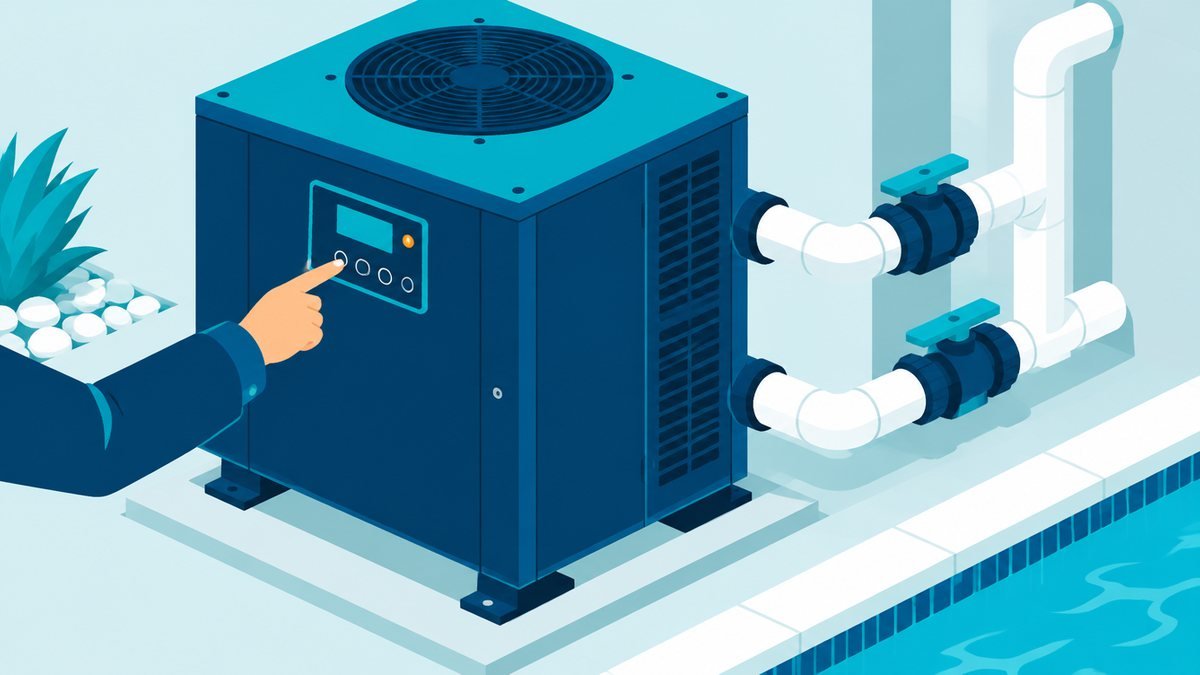
A Hayward pool heater is one of three kinds: a gas heater from the Universal H Series, an older induced draft gas heater such as the H100, or an electric heat pump from the Summit and HeatPro lines. Which one you own decides how it lights, what its display codes mean and what you can safely check yourself. Hayward publishes troubleshooting guides for each family, and they agree on the most important points: most problems come down to water flow, power, gas supply or chemistry. This guide explains the Hayward pool heater families, how to read their codes and which checks are safe for an owner.
The Hayward pool heater families
| Family | Type | Notes from Hayward’s guides |
|---|---|---|
| Universal H Series (HxxxFD) | Gas, natural gas or propane | Electronic ignition with a blower, a keypad display and diagnostic codes. Models from H150FD to H400FD |
| H100 | Gas, induced draft | Sequence includes a water pressure switch, air pressure switch and a two-speed blower |
| HeatPro and Summit heat pumps | Electric heat pump | Use refrigerant, run on 240 volts and show codes such as LP, HP and Flo |
For a general explanation of the gas type, see gas pool heater, and for the heat pump principle, see pool heat pump. Model numbers and parts differ by year, so always use the data plate on your own heater.
Universal H Series diagnostic codes
Hayward’s consumer troubleshooting guide for the Universal H Series lists the codes the display can show. Use it to learn what the heater has detected before you call a technician.
| Code | Meaning in Hayward’s guide |
|---|---|
| IF | Ignition failure |
| IO | Ignitor circuit open |
| AO | Blower vacuum switch open |
| AC | Blower vacuum switch closed |
| LO | Water pressure switch, vent pressure switch or temperature limit switch fault |
| HS | Maximum return water temperature exceeded or a rapid water temperature rise |
| SF | Temperature sensor input failure |
| HF | Flame present with the gas valve not energized |
| CE | Communication error between the control module and the display |
| PF | Voltage polarity reversed or low voltage detected |
| BD, EE, SB | Board faults or secondary high voltage fault, and keypad failure |
Hayward says to contact a local authorized service center for service on these codes. A code is a starting point, not a verdict, so write it down before you reset the heater.
What to check first on a gas model
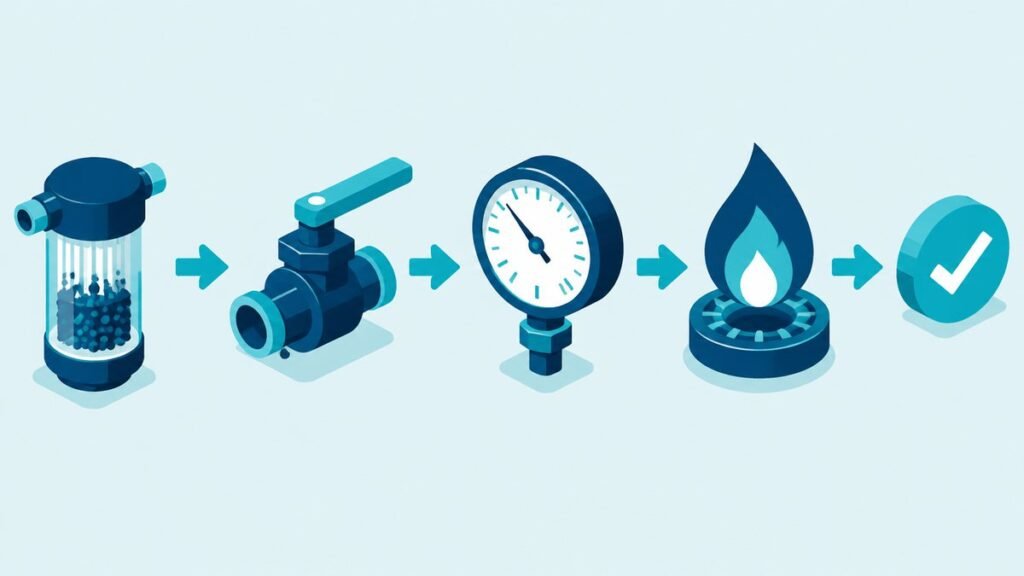
- Is the pump running and the filter clean? Hayward’s H100 guide starts every no-ignition case with flow. Check the pump, the filter, the skimmer baskets and the pump basket.
- Is the flow in range? The H100 guide says flow must be between 20 and 70 gallons per minute, and the Universal H guide lists minimum flows from 20 to 40 gallons per minute depending on the model, with a maximum of 125.
- Try the return-fitting test. Hold your hand over a return outlet to reduce the return flow. If the blower comes on and then shuts off when you take your hand away, Hayward says a smaller eyeball fitting is needed at the return.
- Is the thermostat set above the water temperature? It sounds obvious, but a setpoint below the pool temperature will not call for heat.
- Is power and gas available? Check the breaker, the on/off switch and the gas shutoff. Do not go further if you smell gas.
How the sequence helps you read a problem
On the Universal H Series, the heater checks the blower switch, runs a pre-purge for about twenty seconds, confirms the switch has closed and then tries to light the burner for a four second trial. If the trial fails, it retries and after three failures it locks out with an IF code, waits sixty minutes and tries again. If you hear the blower run and then the heater stops, the problem is likely in the ignition or flame sensing steps. If the blower never starts, the issue is earlier in the chain, such as power, a switch or the control. Our guide to pool heater repair has a longer checklist.
Hayward heat pump codes
The heat pump guide covers HeatPro and Summit units charged with R-410A refrigerant. Several of its codes are about water flow, which an owner can check.
- Flo or PS. An open water pressure switch. Hayward says most of these errors are flow related: confirm the pump is running, the filter is clean, bypass valves are set properly and any timer is in its on cycle.
- HP or HI. The high pressure switch has opened. Hayward says the most common cause is restricted water flow, often from a bypass valve, and that its heat pumps require at least 30 gallons per minute, and more at higher water temperatures.
- LP. The low pressure switch has opened, most often because of a loss of refrigerant from a leak. This needs a technician.
- PO, OP, Pc, SH and the d-versions. Water or defrost temperature sensor faults.
- FS or dEF. The unit is in defrost mode, which Hayward says is normal when outdoor temperatures are in the low to mid 50s Fahrenheit or below.
Water chemistry and heater damage
Hayward’s Universal H guide shows photographs of heat exchanger damage from high pH, high alkalinity or calcium hardness, low pH, high sanitizer levels, low or high water flow and freeze damage. Keeping the water balanced protects the heater, and our guide to how to lower pH in pool water explains one of the common adjustments.
Settings you may need
The Universal H guide describes a temperature lock-out that sets a maximum for the pool and spa. Its default maximums are 90 degrees Fahrenheit for the pool and 104 for the spa on heaters made after February 25, 2011, and the maximum spa setpoint is 104. It also describes a bypass mode, shown as bo on the display, that lets an external controller run the heater. Use your own manual for the exact key presses on your keypad.
When to call a technician
Call a professional for gas valve, ignition, board, wiring or refrigerant faults, for repeated lock-outs and for any sign of heat exchanger damage. Hayward’s heater guides say heat exchanger inspection should be done by an authorized service center. Take photos of the display and the model and serial label before you call, as Hayward suggests for exchanger inspection.
Frequently asked questions
Why does my Hayward pool heater show IF?
IF means ignition failure. Check the gas supply, flow and power, then call a technician if it repeats, since the heater will keep retrying on a schedule.
What does the LO code mean?
Hayward lists LO as a fault in the water pressure switch, the vent pressure switch or the temperature limit switch. Flow is the first thing to check.
Why is my Hayward heat pump not heating?
Common reasons are low flow, a pump timer in its off cycle, defrost mode in cold weather or a sensor fault. Check flow first.
Can I reset a Hayward heater?
You can cycle the power at the breaker and see whether the code returns, but write down the code first. A repeated code needs diagnosis.
Sources
Instructions can vary by brand and year, so keep your manual close while you work. The references below support the details in this guide.