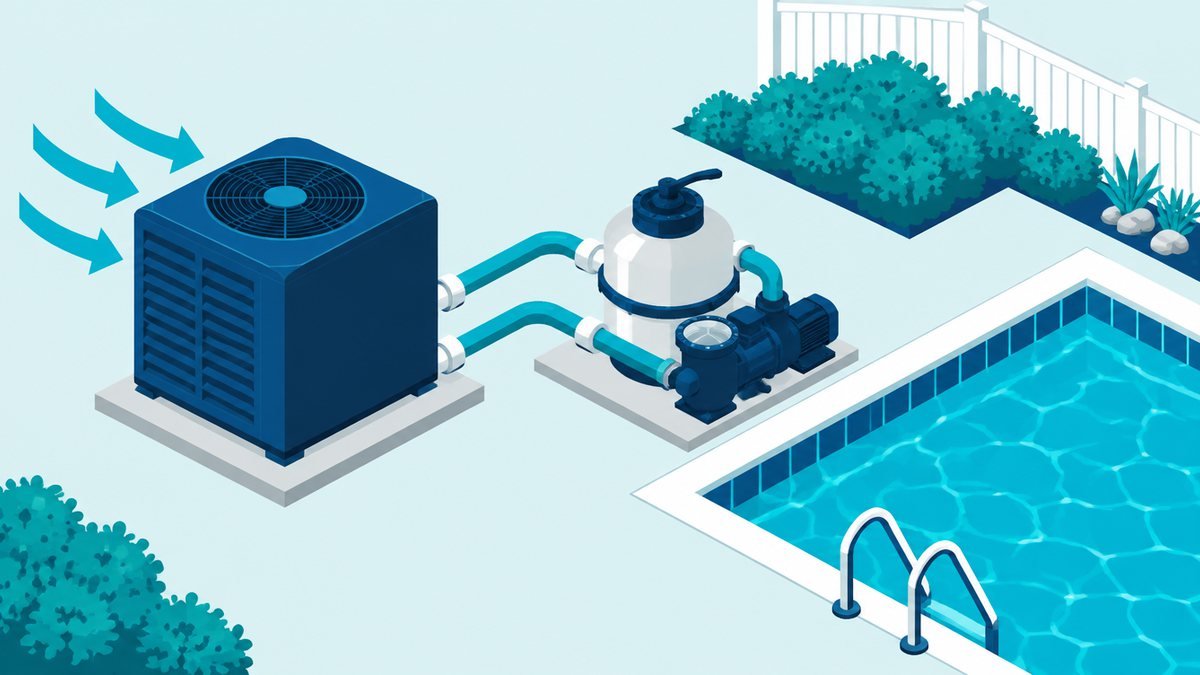
A pool heat pump warms pool water by moving heat from the outside air into the water, rather than burning fuel or running a resistance element. It uses a fan, an evaporator coil, a compressor and a condenser that sits in the water path, much like a home heat pump in reverse. Because it moves heat instead of making it, it can deliver more heat than the electricity it uses, which is why many owners choose one for a long swimming season. The trade-offs are a higher purchase price and slower, weaker performance when the air gets cold. This guide explains how a pool heat pump works, how it compares with other heaters and what to check before you buy or troubleshoot one.
How a pool heat pump works
A fan pulls outdoor air across a coil filled with refrigerant. The refrigerant absorbs heat from that air and turns to a gas. A compressor raises the pressure and temperature of the gas, and the hot gas passes through a heat exchanger where the pool water, pumped through by your regular circulation pump, picks up the heat. The refrigerant then cools, condenses and returns to the coil to start again.
Hayward’s troubleshooting guide for its heat pumps describes the same sequence from the service side. It says the unit waits about three to five minutes after power is applied before it starts heating, because the delay protects the compressor from short cycling, and that a heat pump will not run when the pool pump is off. It also says the best way to confirm a unit is heating is to compare the temperature of the air entering the coil with the air leaving the fan, and that a difference of roughly 15 to 20 degrees Fahrenheit is normal for the models it covers.

Pool heat pump compared with other heaters
| Heater type | Energy source | Best for | Watch out for |
|---|---|---|---|
| Heat pump | Electricity plus heat from the air | Steady, efficient heating through a long season | Slower heating and lower output when the air is cold |
| Gas heater | Natural gas or propane | Fast heating in any weather | Fuel cost, venting and gas line requirements |
| Electric resistance heater | Electricity only | Small pools and spas | High power draw for the heat produced |
| Solar heating | Sunlight | Sunny locations with roof or ground space | Output depends on weather and daylight |
Our guides on the gas pool heater and the above ground pool heater cover the alternatives in more detail.
What affects pool heat pump performance
- Air temperature and humidity. The cooler the air, the less heat there is to collect. Hayward’s guide says that when outdoor temperatures drop to the low or mid 50s Fahrenheit or below, a unit may enter a defrost mode, which is normal operation.
- Water flow. Heat pumps need enough water moving through the heat exchanger. Hayward says its units require a minimum of 30 gallons per minute, and that more may be needed at higher water temperatures. A dirty filter, a closed bypass or a pump on a timer in its off cycle are the usual reasons for flow errors.
- Pool size and cover use. A bigger pool needs more output. The Department of Energy’s pool heater rulemaking notes that a pool cover can save up to 50 to 70 percent of overall energy use, which is a large effect for a small cost.
- Wind and shade. A sheltered pool loses less heat, and the unit needs clear airflow around it so it does not recirculate its own cold exhaust air.
- Run time. A heat pump works best running for longer periods at a steady setpoint rather than being switched on for a short burst.
Sizing and placing a pool heat pump
Manufacturers publish sizing tables based on pool volume, surface area, the temperature rise you want and your climate, so use the table for the exact model rather than a rule of thumb. When you compare models, look at the rated output, the electrical requirements and the conditions under which that output was measured, because ratings are usually quoted at a specific air and water temperature.
- Place the unit on a level pad, outdoors, with the clearances the manual asks for on all sides.
- Keep it away from walls or shrubs that block the airflow at the top and sides.
- Plan for a drain path, because the coil removes moisture from the air. Hayward notes that as much as 3 to 5 gallons per hour of run time is common in humid areas, which is normal and does not mean a leak.
- Have a licensed electrician connect the circuit. Hayward notes that pool heat pumps run on 240 volts, so the breaker, wiring and bonding must meet local code.
Common pool heat pump problems
Many problems have simple causes you can check from the outside. Our guide to pool heater repair goes through the checks that apply to every type.
- No heating, display shows a flow message. Confirm the pool pump is running, the filter and baskets are clean and any bypass valve is set correctly. Hayward says most flow errors come down to these causes rather than a failed switch.
- Water pooling under the unit. Condensation dries up within a few hours and stops when the unit stops. A real leak continues when the unit is off. Hayward suggests testing the puddle with a chlorine test strip: little or no chlorine suggests condensation, while chlorine similar to pool water suggests a leak.
- Unit runs but the water does not warm. Check the setpoint, the cover, the air temperature and the flow. In cold weather the heat pump may simply not have enough heat to collect.
- Low-pressure or high-pressure error codes. These point to a refrigerant or flow problem that needs a technician.
Running cost and efficiency
Heat pump efficiency is usually expressed as a coefficient of performance, the ratio of heat delivered to electricity used. The number is higher in mild weather and lower in cold weather, so compare ratings at the same conditions. Your actual cost depends on your electricity price, the pool size, the temperature you hold, how much you use a cover and how many months you swim. The U.S. Department of Energy’s rule also sets efficiency standards for consumer pool heaters, and the rule document explains how the standards are measured.
Frequently asked questions
How does a pool heat pump work?
It uses a fan to pull outdoor air across a refrigerant coil, a compressor to concentrate the heat and a heat exchanger to transfer it to your pool water as the water flows through.
Does a pool heat pump work in cold weather?
It works, but with less output as the air cools, and it may spend time in defrost mode. In very cold conditions a gas heater is often a better match, or you may choose to close the pool for the season.
How long does it take a heat pump to warm a pool?
It varies with the pool size, the starting temperature, the unit’s output and the weather, and it is usually measured in days rather than hours. A cover shortens the time and holds the heat.
Is it normal for water to drip from a pool heat pump?
Yes, in humid air the coil collects moisture that drains away. Check for chlorine in the water to tell condensation from a leak.
Sources
For your exact model, the manufacturer’s documentation is the authority. These sources are good places to start.